

In this guide:
It used to be the exception. Now, for most agencies chasing decent-sized budgets, it's close to the rule. You build the relationship, the client wants you, and then the deal goes to procurement, and everything changes.
The advice has been the same for years. Get ahead of it. Build the relationship early. Most agencies nod along, then wait for the RFP anyway, because that's what's always worked.
It felt like a reasonable bet, until budgets got bigger and buying committees got longer. Then AI arrived, and gave procurement a new question to ask.
Now the agencies still waiting for the brief to land are already behind.
Watch our agency experts cover procurement (25 mins)
Prefer to read? Continue below for the complete guide.
Why client procurement is becoming the norm for agencies
Procurement involvement in agency selection used to be occasional. Now it's close to routine, especially once budgets cross a certain size or come from a larger organisation. In smaller organisations, finance often plays the same role under a different name.
AI is adding a new pressure point on top. Tell a client you're delivering the same work in half the time because of AI, and the next question is obvious: why are you still paying the same fee? Procurement now has a new lever to pull, and “that's the price” doesn't hold up on its own anymore.
Either way, the relationship you built stops being the thing that wins the work. A spreadsheet does. You go from being the agency they want to being one line next to two others they've never met.
Procurement isn't going away. Its role in agency selection is only growing. So the real question isn't how you avoid it. It's how you get ready for it.
The real reason agencies lose procurement-led pitches
Here's a myth worth clearing up first. Agencies rarely actually lose on price.
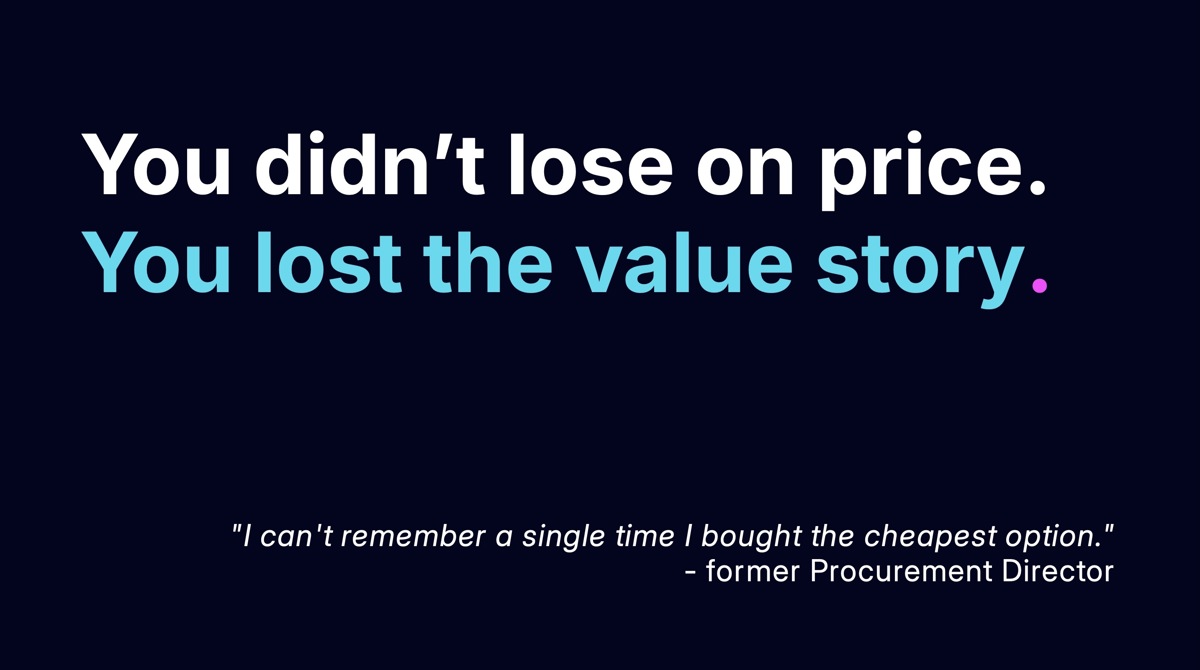
What happens instead is another agency comes in with a stronger value story. The agency that lost gets told it was the price. That's the easier thing to say. It's rarely the real reason.
“I can't remember a single time I bought the cheapest option.”
Former procurement director, speaking to Synergist
What procurement actually wants from an agency
It helps to remember procurement isn't there to make your life difficult. Their job is to optimise the marketing budget, not simply cut it, make sure quality holds up, and manage risk on the client's behalf.
That's why they ask the hard questions. It's not personal. It's the job. Once you see it that way, you stop treating procurement as an obstacle to get past, and start treating them as someone you need to give a clear answer to.
So what does procurement actually want to hear? Not a bigger number or a bolder claim. A clear, specific account of the value you actually bring.
Strategic alignment. Do you actually understand what the client is trying to achieve?
Transparency. Can you explain how you got to your number?
Quality. Does the work hold up?
Reliability. Do you deliver what you promised, on time?
Proactive ideas. Are you bringing them things they haven't asked for yet?
Score well on those five, and procurement stops being an obstacle. They become the person defending your number to everyone above them.
Is quality and reliability enough to win on their own. Not once you're being directly compared. By the time procurement has your quote next to someone else's, everyone in the room already expects the work to be good and delivered on time. That's not a differentiator, it's the entry ticket. Strategic alignment and proactive ideas are what actually win a side-by-side comparison, because they're harder to copy, and harder to put a number next to.
How agencies can get ahead of procurement, before the RFP exists
The five criteria above are the general picture. On any specific deal, they get weighted differently, and others can get added on top: sustainability, diversity, data security. Don't guess.
Before you submit anything, ask your client contact who else will be involved in the decision, and what criteria procurement is actually scoring against this time. Most marketing contacts know the answer. Most agencies never think to ask.
If nobody's told you there's a scorecard, that doesn't mean there isn't one. It means you're being judged against criteria you can't see.
The earlier you do all this, the better. By the time an RFP lands in your inbox, you're often already behind. Whoever built the relationship before that point has shaped the brief.
There's a name for this: the Day One List. Research from Bain and Google found that 86 percent of B2B buyers already have a shortlist in mind before they start any formal search, agencies they'd consider without being asked. And 92 percent of those buyers end up buying from someone already on that list.
So the real new business question isn't just how you win the pitch. It's whether you were ever on the list before the pitch existed.
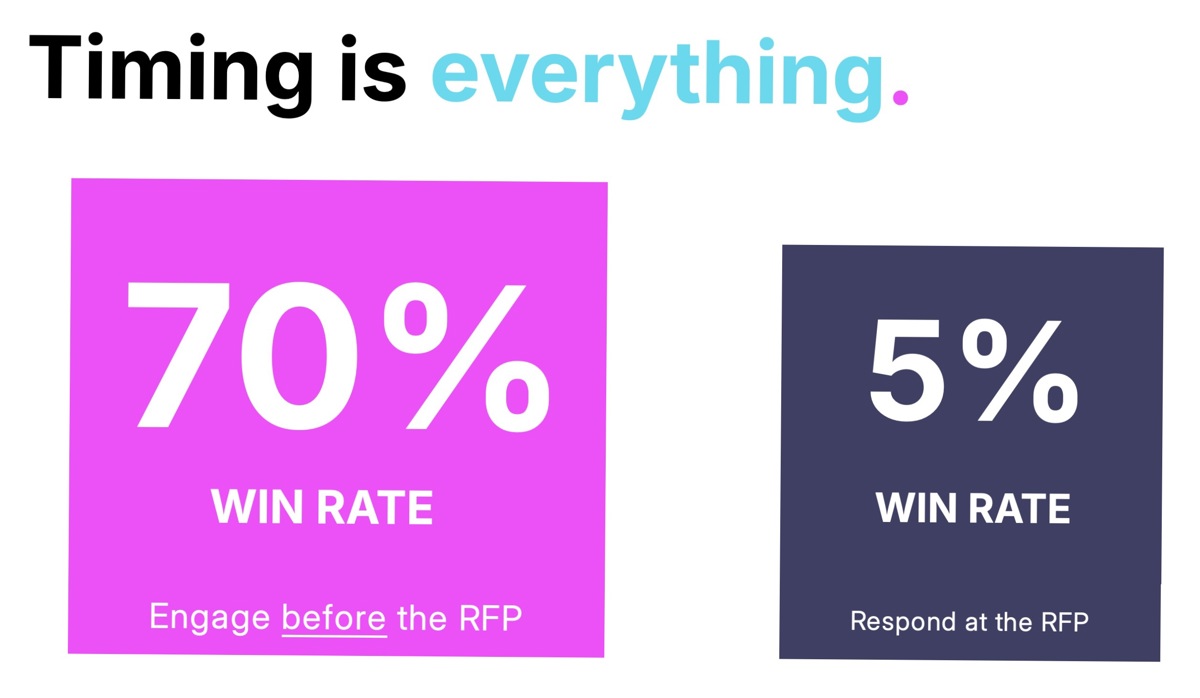
“Agencies who engage around 18 months before a big opportunity comes up see win rates over 70 percent. Agencies who wait for the RFP and respond cold see win rates closer to 5 percent.”
Procurement leader, speaking to Synergist
That's not a small gap. Getting onto that list isn't really about procurement at all. It comes down to visibility in your market, a distinctive position, and being known for the right kind of thinking well before anyone is actively buying.
How agencies can make a quote impossible to compare on price
Procurement doesn't set out to buy the cheapest option. But if your quote reads like a list of hours and deliverables, price is the only thing left for them to compare it on. You've made their decision for them, whether you meant to or not.
Name what's actually driving the price. If the strategic thinking sits in the first two weeks, say so, and say what's in it. If the proactive ideas came from work most agencies wouldn't have bothered doing, put them in the quote, not just the pitch.
Do that, and procurement isn't comparing three lists of hours anymore. They're comparing one list of hours against something they can't put a number next to.
Assume procurement will challenge your day rate or your fee. Don't wait for it. Answer first.
This is one of the most common complaints procurement raises: a number with no detail behind it. Whether it's your standard day rate or a fee that's gone up since last time, “that's the price” isn't enough to justify it, and it makes procurement's job of defending it internally much harder.
Give them the detail instead. What's driving the number, what it actually costs to deliver, how it compares to similar projects. That turns your pricing from a demand into something they can take up the chain and stand behind.
This is where proper job management does the work for you. If you're tracking job costs through your agency management or project management system, you already have the evidence procurement is asking for: what a project actually cost to deliver, how that compares to what was quoted, where the fee genuinely came from.
Should agencies price on outcome instead of hours? If you want to go further, the starting point is scoping around what the work needs to achieve, not the time it takes to deliver it. That changes the conversation from “here's what you're getting” to “here's what this is going to do for you.” We've covered that shift in full in our guide on value-based pricing for agencies.
How agencies keep the advantage after they win the work
Procurement rarely negotiates on price alone. Payment terms. Contract length. How flexible the scope can be once the work starts. All of that is on the table, and most of it costs you less than a discount does.
Know what you can move on before you're in the room. If payment terms matter more to them than the headline number, faster invoicing might close a gap a price cut never would.
Winning the work is not the end of the procurement relationship. It's the start of a different one, and a useful one.
Put a proper cadence of reviews in place with your procurement contact, quarterly or otherwise, not just the client team. Use it to keep showing the value you're delivering, not just reporting on delivery. Ask them directly what value looks like from where they sit, and how you could be showing it better.
It also means procurement isn't only hearing from you when there's a problem or a price to defend. They're hearing from you when things are going well too, and that's what makes them an ally next time, not just an obstacle to get past.
Start building a procurement partnership.
Here's the honest truth about everything covered in this guide. It's not really about procurement.
The tactics, getting in early, tightening the quote, having the evidence ready, are the easy bit. You can start doing that this week. What's harder is the shift underneath it: seeing procurement as someone doing a job, not someone standing between you and the deal.
Most agency people brace for procurement the way they'd brace for a difficult conversation. But the agencies with the best win rates, and the best retention once they're in, are the ones who stopped treating procurement as a hurdle to clear and started treating them as someone worth keeping informed.
That's not a tactic. It's a relationship. Get that right, and the pricing conversation takes care of itself.
Want to see how Synergist helps agencies track job costs, manage rate cards, and build the evidence procurement asks for? Book a demo