

In this guide:
The advice has been on the conference circuit for a decade. Stop selling time. Start charging for value. And most agencies have sat in the audience, nodded along, and gone back to their day rates.
It felt like an interesting idea for someone else to try. Clients were used to day rates. It was easier to just send the number.
Then AI arrived. And the pricing conversation agencies have been putting off became urgent
Watch our agency experts cover the shift (20 mins)
Steve Vincent and Kate Bastable bring over 20 years of agency experience between them, covering why the time-based model is under pressure and what to do about it.
Prefer to read? Continue below for the complete guide.
Why AI is making agency pricing harder to defend
AI is making agency work faster. Copy that took a day now takes a morning. Research that took a week takes an hour. Concepts that needed three rounds of iteration are sharper first time.
That's brilliant unless you're charging by the hour or by the day.
If your income is tied to time, getting faster is a direct hit on revenue. The tools that should be your biggest competitive advantage are quietly shrinking your invoices. And your clients know it. They're using the same tools. They're starting to do the maths.
Which means the question isn't whether to change how you price. It's 'How to price in the age of AI?'
You have three options:
Do it cheaper. A race to the bottom. You've told the client that efficiency is their gain, not yours.
Do more for the same price. This is where many agencies naturally move next. You keep pricing relatively stable, but you increase the amount of value wrapped around the delivery: more strategic input, faster turnaround, more iterations, additional services. And to be fair, this is a much healthier approach. Because now AI is helping you create leverage instead of simply reducing billable hours.
But there's still a limitation here. You're improving profitability operationally, without necessarily improving how the market values what you do. You're still anchored to the old pricing logic. So yes, your margins may improve internally, but you're still not fully capturing the upside of becoming dramatically better, faster and more effective at delivering outcomes.
Hold the price and defend the value. The right answer. The price was never based on the time. It was based on what you're delivering. AI hasn't changed the deliverable. If anything, it's improved it. Faster doesn't mean less valuable.
Value-based pricing for agencies: a clear definition
Value-based pricing is pricing based on the perceived value of what you deliver, rather than what it costs you to produce it. That's the textbook definition, and it applies across industries from designer fashion to concert tickets to professional services.
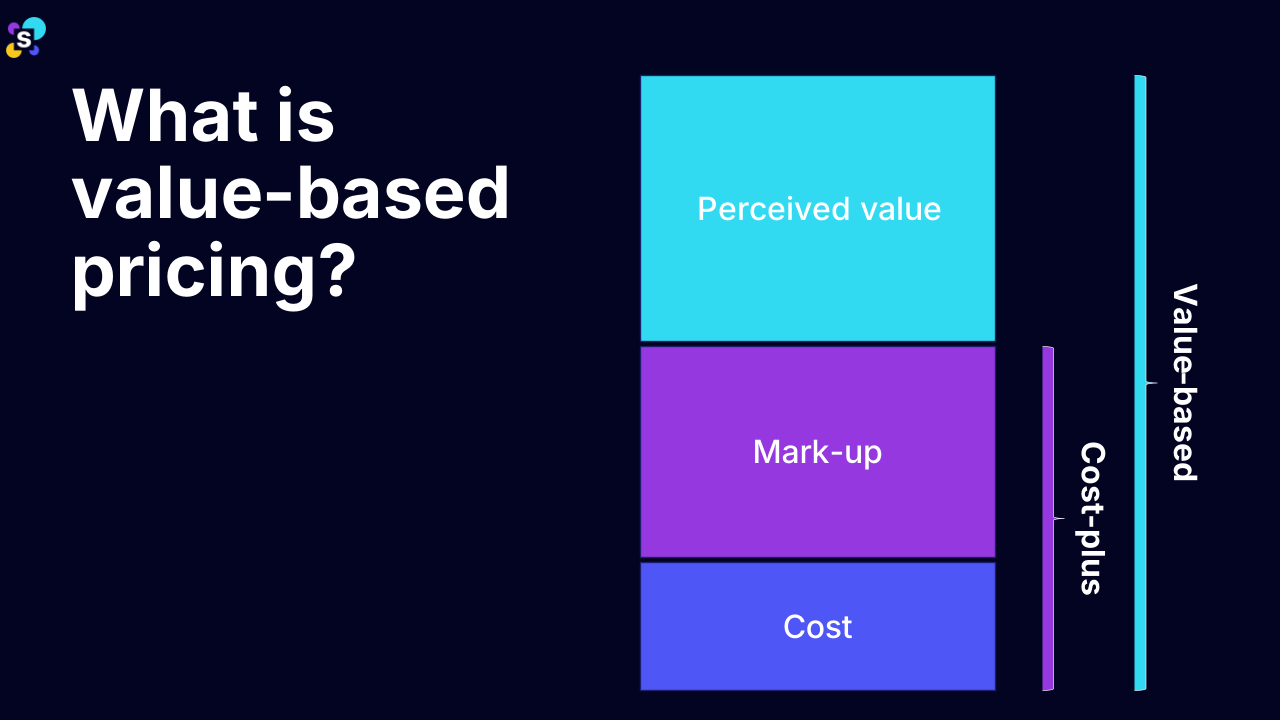
For agencies, the confusion comes from how the idea got interpreted. When value-based pricing entered the agency conversation, it often came packaged with an extreme version: charge a percentage of what the client makes. Take a share of the upside. Align your fee with their results.
In theory, it makes sense. In practice, clients won't agree to it, attribution is nearly impossible, and it creates more commercial complexity than it solves. Most agencies heard that version, decided it wasn't workable, and went back to their day rates.
But that threw out the right idea along with the impractical one.
Value-based pricing doesn't mean revenue share. It means a fixed price anchored to the scope and outcome. Pricing what you deliver based on what it's worth to the client, not how long it takes you to produce it. The shift is from "here's our day rate, here's how many days" to "here's what we're going to deliver, and here's what that's worth." Practical, specific, and achievable this week.
What are clients actually paying for when they hire an agency?
The underlying argument for value-based agency pricing is this: agencies were never really selling time. Time was just the unit of measurement they used to package something that was never about hours at all.
Here's what clients are actually buying when they hire a good agency.
Proven frameworks and methodology
The structured way an agency approaches a brief, a strategy, a creative problem. Built and refined over years of practice. Clients are buying access to a way of thinking that gets better results. That's proprietary. No competitor has the same one. AI has no methodology. It optimises for what has already worked.
Real creative thinking
Not a list of options. The right answer. The idea that stops people in their tracks. The kind of creativity that only comes from genuinely understanding people: what moves them, what they care about, what will make them feel something. That requires human empathy, cultural instinct, and the courage to back something original. AI can't feel the cultural moment. It can't read the room. And it can't inspire. It can only generate.
Years of cross-sector experience
The judgement that comes from working across dozens of clients, markets, and briefs. Knowing what works because you've seen what doesn't. That pattern recognition takes years to build. AI hallucinates. It presents fiction as fact with complete confidence. Someone with real experience knows what to verify, what to challenge, and what to throw out entirely. That can't be prompted into existence.
Accountability
Someone who owns the outcome and will push back when the brief is wrong. AI agrees with you. Good agencies don't always. That challenge is part of what clients are paying for.
The ability to get it done
Most clients don't have the time, the headspace, or the team to do this themselves, even with AI tools available to them. They need someone who takes it off their plate, owns it, and delivers something worth having. That's not a small thing.
But with AI, can't agencies do it cheaper?

This is the question clients are starting to ask. It deserves an honest answer.
Yes, some production costs have come down. First drafts, research, initial concepts. AI has made certain tasks faster and cheaper. The time saved goes into doing the work better, not into a discount.
But experience, frameworks, creative judgement, and accountability: none of that got cheaper. That's what clients are paying for. And that's what a ChatGPT subscription doesn't give them.
"Clients aren't paying you to upload their brief into ChatGPT. They could do that themselves. They're paying for the expertise, craft, and judgement to take it somewhere ChatGPT can't."
Kate Bastable, Principal Consultant, Synergist
Think of it like this. AI is like a very fast, very capable producer. It can output at speed and volume. But it still needs someone experienced to direct it, judge it, and take it somewhere it couldn't get to alone.
That skill, knowing what good looks like and knowing when AI has got it wrong, sits with the agency's people. Experts trained in their craft: copywriters who know how language works, designers who know what good looks like, strategists who know how to frame a problem. AI is the tool. They're the ones who know how to use it.
What about junior agency roles?
AI hasn't made junior roles redundant. It's changed what they do.
A trained copywriter or designer knows what good looks like. That craft knowledge is exactly what makes them effective at directing AI. They can tell it when it's wrong and push it somewhere better. Juniors are no longer purely producing. They're prompting, judging output, and shaping the work.
Seniors shift too. Less line-by-line review. More feeding the intelligence that shapes everything: market knowledge, customer insight, product understanding, strategic direction. The quality of what goes in determines the quality of what comes out.
Remove the junior layer, and you remove the pipeline that develops senior talent. In five years, agencies without that investment face a skills gap they can't fill.
How to price agency work using a value-based approach
Value-based agency pricing starts before the proposal. It starts in the first client conversation, with the right questions, a clear floor, outcome-based scoping, and a proposal structured around three options.
Here's how to build the approach from the ground up.
Define value with the client first
The best thing an agency can do in that initial meeting is ask more questions than it answers. The agency that asks the best questions wins more than the one with the best credentials deck.
Three questions that do most of the work:
What does success look like? Specific, not vague. A brand that works consistently across all its channels. A website that converts better than the one it's replacing. A campaign that gets cut-through in a new market. The clearer the picture, the stronger the agency's position.
What happens if this doesn't work? This is the one most agencies skip. Understanding the cost of the problem you're solving anchors the client's thinking on value, not price.
What's the commercial upside? You don't need to price against it. But understanding what the project is worth to them means you're pricing from context, not thin air.
These questions aren't the basis for the price. They're how you understand the brief, build the relationship, and position yourself as someone who thinks about the client's business, not just their deliverable.
Know your floor before you price
Value-based pricing doesn't mean guessing. Before landing on a number, agencies need to know their floor.
Even under value-based pricing, you still need to estimate time and costs internally. Not to dictate the price, but to make sure you break even. How long will this actually take? Who's working on it? What are the third-party costs? Everything above that floor is the margin.
The internal estimate also serves as a resource and capacity forecast. It's how you know whether you have the right people available and whether you can take the work on at all. Without it, you're not just guessing on price. You're guessing on delivery.
The estimate doesn't go away under value-based pricing. It just stops being the thing you show the client.
The estimate is not the quote. The estimate is internal: what it will actually take to deliver the work. The quote is what you charge the client. Under value-based pricing, these two numbers can look very different.
Kate Bastable, Principal Consultant, Synergist
Do you still need timesheets?
Yes. Timesheets are how you find out whether your estimate was right. Did the job take what you thought it would? Were the right people on it for the right amount of time?
That matters commercially. Revenue alone doesn't tell you whether a project was healthy. Profitability comes from understanding the real delivery cost behind it. If you don't track the time actually spent, you can't see your true net profit.
Timesheets also give you the visibility that's hard to get any other way. Where time is being wasted. Who's overworked and who's underutilised. Where scope crept in quietly without anyone flagging it. That's the data that lets you run a tighter, more profitable agency.
Under value-based pricing, timesheets aren't a billing mechanism anymore. They're how you keep your resourcing and your profitability honest.
Want to see how Synergist helps agencies track estimates, manage project profitability, and build the data foundation for confident pricing? Book a demo
Scope for outcomes, not tasks
Once you know your floor and you've had the value conversation, it needs to show up in how you scope and propose the work.
The shift is from tasks to clearly defined deliverables, priced as a whole rather than as a collection of hours.
A task-based scope says: 12 social posts, 1 email, 2 rounds of amends.
A deliverable-based scope says: a campaign to get your Q3 product in front of the right buyers before the quarter closes.
The first version invites the client to count things and decide whether they're getting enough. The second invites them to decide whether it will work. If they believe it will work, the number of posts is irrelevant.
Structure your proposal for yes
Lead with the problem the work is solving. Restate what the client told you before proposing anything. It shows you listened and anchors everything that follows in their language. And include a clear "what success looks like" section: specific, defined, agreed upfront. That's what protects you if scope starts to drift.
Most agencies send one option. But that puts the client in a yes-or-no decision, and if the answer is no, you're negotiating price before you've had a chance to talk about value. Offer three options instead. A foundation option that solves the core problem. A mid option that adds depth or breadth. A premium option that delivers everything. Lead with the premium: present it first. It resets what the client considers reasonable before they see the other numbers.
Three things happen when you do this. The client moves from "do I buy?" to "which do I choose?" Price stops being the focal point. The deliverable becomes the comparison. And you get a clearer read on what they actually value.
Don't put the price on page one. Build the case first: problem, approach, deliverable. By the time they see the number, they've already bought into the thinking. And call it an investment, not a cost. Small language shift, real positioning difference.
What if a competitor quotes cheaper?
This is the one that makes most agencies panic. A competitor has quoted less, usually on a day rate, and the temptation is to match it or justify yours.
Don't.
If a competitor has quoted less on a day rate, they're selling time. You're selling a defined outcome priced on expertise. The unit of measure is different because the offer is different.
Bring the client back to the deliverable. Did the brief change? Did the quality drop? Did what you're delivering become less valuable? If none of those things changed, the price hasn't changed. What changed is how efficiently you can deliver it. That's the agency's gain, not the client's.
Some clients will still choose the cheaper option. The ones who buy on price alone are rarely the clients who value what the agency does. Losing them isn't always a loss. The agencies that hold their price consistently are the ones building a client base that buys on expertise. Those clients stay longer, push back less, and refer more.
How to move to value-based pricing with existing clients
Most agencies find it easy enough to start fresh with new clients. The harder question is: what about the clients you've had for years who are used to a day rate?
Don't try to flip everything at once. It's gradual, and it's built on trust.
Start by looking at your last five projects. What did you charge versus what did it actually cost you to deliver? Where's the gap? That's your starting point for understanding whether your current pricing is actually working.
Then find one upcoming project and price it as a fixed deliverable. Scoped around what it's going to achieve, priced on expertise not hours. Just one. Start there.
And prepare for the day rate question before you need to answer it. Write down how you'll handle it — not after you've already sent the number.
None of this requires a company-wide overhaul. It just requires starting.
Stop pricing time. Start selling value.
Here's the honest truth about everything covered in this guide.
It's not really about pricing.
Value-based pricing is the commercial model: fixed price anchored to scope and outcome. That's the easy bit. You can change that this week.
What's harder is the shift that has to happen before any of that. How you walk into a meeting. What questions you ask. How you talk about what you do and why it matters. That's value-based selling. And without it, the pricing model doesn't stick.
Most agency people don't think of themselves as salespeople. In fact, most actively resist that idea. But if you can't articulate your value clearly, confidently, and in the client's language, no pricing model in the world will save you. The best proposal structure means nothing if the conversation that precedes it hasn't already established what the work is worth.
What we're really talking about is being able to say, with complete confidence, here's the problem we solve, here's what that's worth, and here's why we're the right people to do it. Not apologetically. Not buried in a task list. Front and centre, before price is ever mentioned.
That's not selling in the way most agency people fear it. It's just being clear about your value.
And clarity, as it turns out, is the best commercial skill an agency can have. Get that right, and the pricing takes care of itself.
Want to see how Synergist helps agencies track estimates, manage project profitability, and build the data foundation for confident pricing? Book a demo