

In this guide:
Want to take your agency from good to GREAT?! Silly question? BUT are you tracking the right stuff to make it happen? Are you tracking the right stuff at the right time? Are you doing anything with it?
To move forward, you need to know what's going on in your agency. And what to do about it when it needs to be better.
Agency profitability: how to measure and improve it
Profitability is the measure of how much revenue remains after costs, and it’s one of the most important metrics to track and report.
The more profit you make, the more you can reinvest in your people and growth strategy, ultimately increasing your agency's value.
If you want to benchmark your agency’s performance, % EBIT (Earnings Before Interest and Taxes) - also known as operating profit - enables you to compare against your past performance or other agencies. EBIT's also used as a key measure of your agency’s valuation by financiers and acquirers looking to buy an agency.
Target EBIT (operating profit) for agencies is around 20%. If salary costs are being controlled to 55% of gross profit then that leaves 25% for the rest of the agency’s overheads and 20% operating profit. (Agency Works)
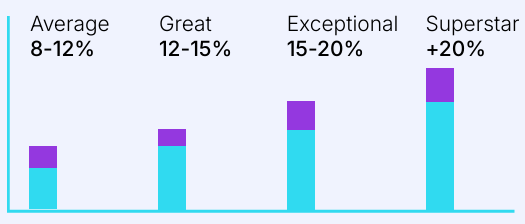
What good agency EBIT looks like
The concept is simple: when revenues exceed costs, you’re profitable. But the reality can be more complex. Simply chasing after revenue often doesn’t lead to increased profits. You could just be pursuing top-line ‘vanity figures’. Remember: revenue for vanity, profit for sanity.
How can you increase profitability?
Download the Agency Profit guide
It's important to look beyond revenue and consider how much of it translates into profit. You might be surprised to find that the big project or long-term client isn't the most profitable.
Working out your most profitable areas can give you a big competitive edge. It might feel counterintuitive to turn down work or ditch clients, but hanging on to unprofitable work just makes you busy, not successful.
Project profitability
Which projects generate the most profit and why? Factors that affect profitability include:
- Type of work
- Time spent
- Project team
- Project management
- Account handler
- Client
Look carefully at whether you're estimating projects accurately. Are you charging for additions when there’s scope creep? If projects are regularly running over, why is that?
Overservicing by 10% means you’re effectively spending about 6 weeks of the year working for free. (Read: How to stop overservicing)
To get the level of insight you need, ideally you should:
- Track actual time and costs vs estimated, quoted and invoiced values, in real time.
- Break complex projects into phases, so you can estimate and report on project profit in more detail.
- Run profitability reports by job type, service type, account manager or team.
According to the BenchPress Profit and Growth report, agencies that measure gross profit by project are consistently the most profitable. (The Wow company)
Top tip: Reviewing in real time helps you spot any projects that could overrun so you can get back on track. Agency management software, like Synergist, can help you stay in control by letting you set alerts when budgets or timing hit certain thresholds.
Client profitability
Tracking client profitability shows you which clients are boosting your agency's profit margins... and who could be draining them.
Do you know your treasure clients: the ones who consistently make you money? And the vampire clients: those who take up more time than they paying for?
Understanding the value of your clients can help you prioritise sectors, services, time and attention more effectively.
Specialist agency management software allows you to track client revenue, gross profit and net profit, plus ‘client investment’: the difference between the recommended charge and how much you've billed across all their jobs. Learn more about measuring and improving client profitability.
Top tip: Acquiring new clients costs money – think marketing, sales, pitches and procurement. Make sure you track your time and cost investment so you can recover it when you win the work.
Agency pipeline forecasting: managing new and existing clients
Pipeline forecasting is the process of predicting future work opportunities so you can plan resources, manage peaks and troughs and track ongoing trends.
Forecasting can also support your strategic planning, helping you identify opportunities and risks. Plus, it’s a great client management tool, establishing whether your client spending is on target.
Most agencies produce pipeline reports for new and existing clients. But are you properly drilling down into the numbers?
Top tip: Use weighted forecasting to assess the value of an opportunity based on the likelihood of it coming to fruition. For example, if a job is worth £4,000 with 75% probability, your pipeline will forecast £3,000. Tools like Synergist CRM let you add a % weighting to each opportunity. Synergist will then calculate the ‘Weighted value’ of the opportunity for you and give you a more accurate forecast.
New business forecasting
To achieve year-on-year growth, you should aim for 25% of your income to come from new business.
Winning new business is now the number one challenge for 46% of agency owners. (BenchPress 2025)
Start by asking whether you’re generating enough new leads and opportunities. Calculate your current win ratio and average sales value. How many opportunities do you need to hit your target? And how many conversations will it take to get there?
Other things to monitor are whether you’re attracting the right opportunities and types of work. That means taking an in-depth look at the opportunities you’re winning – and the ones you’re losing.
It’s easy to focus on the opportunities you win, but it’s equally important to track your losses. Ask:
- What type of opportunities are you winning?
- Are wins coming from certain sectors or services?
- What type of opportunities are you losing?
- Why are you losing, and who to?
By spotting patterns, you can replicate success and reduce losses. Essentially, tracking your successes and failures can help you make better decisions next time around.
Top tip: For both wins and losses, the most important metric is time and cost to close. Monitor how much time you spend on new business pitches. If an opportunity is worth £100k then, once you’ve invested £5k (5% of this value), take stock and ask if you’re in a strong position to win. If not, is it worth continuing?
Existing client pipeline
Client retention is critical for sustainability, and expanding existing accounts is the most cost-effective way to grow gross profit.
No single client should account for more than 20% of gross profit. (Agency Works)
To reduce risk if your agency lose a client, aim for a balanced revenue stream from a range of clients.
It’s important to forecast how much revenue you expect to gain from your existing clients and track against your client targets. Ask yourself:
- Is revenue growing or declining year-on-year?
- Do clients know about all your services?
- Is your team actively promoting and cross-selling to increase client spend?
Most importantly, are your clients happy? Would they recommend you without hesitation? This is a key barometer of success. You could be creating brilliant content and have a superb strategic plan, but if you’re not measuring client happiness you’re not necessarily creating something sustainable.
55% of clients want more from their agency:
- More services
- More expertise
- More focus on value for money
Watch: The key to client-agency chemistry (Agency Works Webinar)
Top tip: As with new business, it’s a good idea to track won and lost opportunities and how much you’re investing. If you’ve incurred costs, can you recoup them over the lifecycle of working with the client?
Capacity planning for agencies: balancing workload and resources
Capacity planning means assessing how much work your team can realistically deliver with the time, skills and resources available.
The natural follow-up to pipeline forecasting, capacity planning is where you figure out how busy your teams really are, and whether you’ll need to hire, bring in freelancers, or push for more new business.
Linking pipeline and capacity forecasting
The most important metric is the gap between estimated work, booked work and available capacity. It tells you three really useful things:
- What skills and time you need to sell to keep teams busy
- Whether you’ve oversold and risk overstretching people
- Whether you should recruit or bring in freelancers
Managing peaks and troughs
Adjusting client deadlines
You can sometimes manage peaks and troughs by working with clients to manage their deadlines to fit your capacity. This is good for your agency, but also reassures clients they’re getting the right people on the job.
Freelancers vs recruitment
Short-term peaks often call for freelancers, while long-term patterns may justify recruiting a new team member. Planning ahead helps you prevent overstretching your budget or your people.
Planning for new skills
Agencies sometimes find they’re offered projects outside their existing proposition. If you think you might need different skillsets in place, you’ll need to plan early so your new hires (or upskilled team members) are ready to go.
Top tip: There isn’t a magic fix to capacity planning, but good processes really do pay off in the long term. And once you know your team’s true capacity, you can find a better balance and protect individuals from burnout… or boredom.
Managing freelance use
Freelancers can be a really useful resource. But, to safeguard profit margins, your processes need to be tight. Ask yourself:
- Are you booking freelancers in advance?
- Do you have a PO system in place?
- Are they completing timesheets?
- Who is managing the freelance budget?
Agency utilisation rates: how to track and improve
Utilisation – the percentage of an employee’s available time that’s spent on chargeable work – is a core metric for measuring agency efficiency and profitability.
High utilisation isn’t about squeezing people, it’s about balance. You want enough chargeable work to hit your profit goals, without overstretching people or making them busy for the sake of it.
Setting realistic utilisation targets
First, you need to make sure you’re accurately calculating utilisation targets rather than just making an arbitrary assessment.
For example, if you think a designer can have 80% utilisation, do they actually have enough capacity for that? Is there enough chargeable work in the pipeline to make it realistic?
Most agencies aim for a utilisation rate between 70-80%. In this sweet spot, the majority of time is spent on billable work, but there’s still capacity for non-billable activities such as training, admin and team meetings.
The industry average agency utilisation rate is around 65%. (BenchPress report)
Check your targets by:
- Talking to your team to understand the full scope of their role, including internal meetings, client calls and admin
- Reviewing historic data to see what utilisation rates have really looked like in the past
You can find more benchmarks and best practices in our agency utilisation guide.
Tracking utilisation vs targets
Once your targets are set, track them closely. Monitoring chargeable vs non-chargeable time tells you instantly if people’s time is being used as planned.
For example, a creative could be spending an hour a week on client update calls. Spotting these hidden time drains helps you protect utilisation rates.
Common red flags to watch for
Nobody wants to be seen twiddling their thumbs in an agency. But a closer look at timesheets can tell you whether you’ve sold enough hours to keep everyone chargeable and busy:
- Logging too much ‘admin’ can be a sign that there isn’t enough chargeable work.
- Logging more time than estimated can happen when team members don’t have another project to move on to.
Both issues can distort your data and hide bigger problems in your agency.
Recoverability
Recoverability is the percentage of your team’s chargeable time that actually gets billed to clients. It shows how much of your utilisation translates into real revenue.
Usually, agencies can’t charge for 100% of their time. Common reasons for this include:
- Underquoting at the start of a project
- Overservicing to keep a client happy
- Strategic write-offs – taking a hit now for a future win
But the biggest culprit of all? Inaccurate or late timesheets
Perhaps people fill them in at the end of the week when they’ve forgotten what they’ve done. Perhaps they forget to post them at all. Whatever the reason, if time isn’t tracked, it can’t be recovered.
3 steps to improving recoverability
- Get the brief right
A clear, detailed brief is the foundation of accurate estimating and quoting. Without it, you’re basing costs on assumptions. - Train teams to push back
Give staff confidence to flag when a project needs rescoping, re-estimating or requoting. Setting parameters makes it easier to show clients when a request is out of scope. - Make time tracking easy
Encourage real-time timesheets. The closer to the work, the more accurate the entry and the higher your recovery.
We have a good case study on improving utilisation and recovery rates here: How ArmstrongB2B marketing agency improved utilisation
Employee engagement in agencies: why it matters for growth
Employee engagement is the measure of how motivated, supported and fulfilled your people feel, and it’s just as important as your financial metrics. Without engaged people, even the best reporting won’t drive growth.
According to 2023 Gallup research, companies with high employee engagement experience 18% more productivity and 23% more profitability than those with low engagement. (Gallup)
Of course, people move on from time to time. But if your people don’t feel valued, turnover rises. And a mass exodus of unhappy people doesn’t say a lot of good things about your agency.
Would your employees recommend you?
You measure client satisfaction, but what about that of your employees? Ask yourself:
- Would your employees recommend you as a great place to work?
- Are they engaged and absorbed in their work?
- Do they feel supported and valued?
- Do they see a future with you, or are they just passing through?
Building a connected, engaged team
For people to thrive, they need a supportive environment where they feel valued and engaged. That means:
- Defining purpose and values
The starting point for agency culture. Make sure your purpose and values are clearly defined and used consistently across recruitment and performance reviews. - Connecting roles to mission
Do employees understand how their roles contribute to the bigger picture? Genuine engagement comes when people see how their work drives the agency’s success. - Supporting individuals and teams
As well as being sufficiently challenged and supported to grow in their roles, employees need to feel trusted to do their jobs and recognised for their contributions.
Top tip: Aim for employee turnover below 10% each year.
What to report on weekly vs monthly
Short-cycle reporting, carried out weekly, helps you react quickly to project, billing or resource issues. Longer-cycle reporting, carried out monthly, lets you step back, see trends, and review your strategy and targets.
What to report weekly
These are mostly operational metrics, giving your client services, project leads or account teams things to act on straight away:
- Actual time vs estimate. Compare the time you estimated with the time logged on timesheets. This gives you a real understanding of how the project’s performing and helps you spot potential overruns.
- Capacity and utilisation gaps. Monitor capacity weekly to see which teams and skills are under- or over-utilised. This will help you fill any gaps productively – perhaps by bringing work forward, strategically over-servicing or working on internal projects.
- Forecast vs invoiced. Stay on top of invoicing and track what’s been invoiced against what you expected to invoice. This shows you when jobs haven’t been invoiced as planned, helping you spot overruns and work that hasn’t landed.
- Pipeline and new opportunities. Look at what’s in the pipeline, what’s likely to land, and how that affects your billing forecast.
What to report monthly
These metrics are more strategic, helping you plan ahead rather than just firefight:
- Profit by client, project type or service. Look at which clients, project types or services are driving profit – it’s a much more helpful metric than revenue.
- Utilisation and capacity trends. Examine how teams have been used over the month and check you have the right skills mix to meet current demand.
- Recoverability. Review how much of your chargeable time was actually billed. This allows you to spot revenue leakage and refine pricing.
- Client satisfaction. Review overall client satisfaction, retention and cross-sell opportunities, and whether any clients are approaching risk levels.
- New business. Review win/loss rates, quality of pipeline and time and cost to close. Adjust new business strategies accordingly.
- Budgets vs forecasts. Analyse performance against monthly forecasts and budgets to inform strategic planning and board reporting.
At a glance: weekly vs monthly reporting
Weekly reporting is about spotting issues early and taking action fast. Monthly reporting is about stepping back to identify patterns, shape strategy and plan for sustainable growth.
|
Area |
Weekly (tactical focus) |
Monthly (strategic focus) |
|
Projects |
Spot overruns early, track actual vs estimated costs |
Review profit patterns and project performance |
|
Capacity & utilisation |
Balance workloads, address gaps fast |
Analyse trends to inform hiring and resourcing |
|
Pipeline |
Check short-term opportunities and demand |
Review win/loss rates and forecasting accuracy |
|
Financials |
Track invoicing and recoverability issues |
Assess revenue leakage and refine pricing/scoping |
|
Clients |
Flag at-risk accounts |
Review satisfaction, retention and concentration |
|
Team |
Monitor workload and morale |
Review engagement and turnover trends |
|
Targets |
Fix small deviations quickly |
Assess overall performance vs plan and adjust strategy |
Top tip: Reporting doesn’t have to be time-consuming: with the right agency management system in place, it’s automatic. With instant access to real-time dashboards and live data, it’s easy to make fast, informed decisions.
The best software for agency reporting
Understanding the metrics that matter is only half the battle. The real challenge is turning them into meaningful, actionable insight.
The right agency management system makes all the difference. When choosing a platform, look for:
- Comprehensive reporting
You need visibility across the full picture: profitability, pipeline, utilisation, recoverability and engagement. Make sure reporting is flexible, detailed, and easily customisable to your agency’s needs. - Real-time data
To make fast, confident decisions, you need a system that lets you track projects, finances and capacity in real time. - Ease of use
Confusing, clunky systems won’t cut it in a busy agency. Choose a tool that makes time tracking, project management and reporting intuitive. - Integration with existing tools
From accounting software to CRM, your platform should fit seamlessly with the tools you already rely on. - Scalability
As your agency grows, your system should grow with you. Look for a platform that can handle increasing complexity without creating more admin. - Support and training
Beyond features, the level of onboarding, support and ongoing training can make or break the success of your implementation.
The right system should give you more than numbers – it should give you clarity, confidence and control.
By investing in an agency management system that delivers accurate, real-time insights, you’ll be in a stronger position to make better decisions, improve profitability, and build a happier, more sustainable business.
See how Synergist helps agencies gain business intelligence with real-time agency dashboards and reporting.
Agency reporting FAQs
What are the most important metrics for agency performance?
Profitability, pipeline, capacity, utilisation, recoverability and employee engagement are widely recognised as the core agency management metrics.
What is a good gross profit margin for an agency?
Industry benchmarks suggest aiming for around 50% gross profit, though only about a quarter of agencies consistently achieve this.
How often should agencies review capacity and utilisation?
Most agencies review weekly to ensure forecasts match actual workload and to make timely resourcing decisions.
What is the difference between utilisation and recoverability?
Utilisation measures how much of your team’s time is spent on chargeable work, while recoverability shows how much of that time is actually billed to clients.
What is a healthy utilisation rate for agencies?
The industry average is around 65%, but top-performing agencies typically aim for 70–80%.
How do you improve recoverability in an agency?
By getting clear briefs, training teams to push back on scope creep, and ensuring accurate, real-time time tracking.
How much new business should an agency aim for each year?
A good rule of thumb is to generate 25% of your income from new business, with the rest from existing clients.
What is a good employee turnover rate for an agency?
Aim for less than 10% per year. High turnover can signal low engagement and risks long-term profitability.
Book a demo
See why thousands of agencies - from design to digital, 10-500 people - choose Synergist to manage their operations more intelligently and profitably.