

In this guide:
Presenting work to a client should be the good bit. The thinking is done, the idea is strong, and now you get to show it off.
So you send it over with a carefully written email. A few hours later, the reply lands. “I'm just not sure it feels right.” “It's not there yet.” “Can we see a few more ideas?”
Then the guessing starts. Your team explains. Defends. Reworks the idea on a feeling. Nobody is sure where it went wrong.
The work was never the problem. The way it arrived was.
Watch our agency experts cover presenting work to clients (20 mins)
Prefer to read? Continue below for the complete guide.
Why client feedback is often about more than taste
Only 30% of agencies and 27% of marketers feel well-trained in evaluating ideas.(Marketing Week)
It's starts with what the client has actually seen. They've seen the answer. But have they seen the rationale, the thinking behind why the idea exists.
Yes, you explained it, in the email. But a client goes straight to the work, because that's what they've been waiting for. The rationale sits in an email that never got read, or in your team's heads.
That matters because creative work has no set answer. Without the rationale, there's nothing to check it against. So the client goes on instinct. Or taste.
In a recent study, 84% of marketers admitted that personal opinion has a big impact on decision making. (Marketing Week)
Most clients were never taught how to review creative work. Being asked for an instant verdict, with their boss watching, isn't comfortable.
Briefs move too. Between kick-off and reveal, someone else's thinking finds its way in, and nobody tells the agency. That is often what sits behind “I'm not sure it's on brief.”
So it isn't a bad client, and it isn't bad work. It's everything the client hasn't been told.
What poor feedback costs an agency
It costs more than a bruised ego.
Extra rounds. Vague feedback produces vague amends. The team guesses, reworks the idea, and shows it again, often to get the same reaction.
Slower sign-off. Nobody knows what would get a yes, so a comfortable deadline gets tight, then missed.
Lost margin. Every extra round is time against a fixed fee that never gets billed. If you track job costs in your agency management system, it's easy to spot: hours that ran past the estimate after the first reveal.
Lost confidence. The client stops wondering about the idea and starts wondering if you ever understood the brief. Do that often enough and it becomes about whether you're the right agency at all.
None of that shows up as a line in the budget. It shows up as a project that went worse than it should have.
How agencies should structure the creative reveal
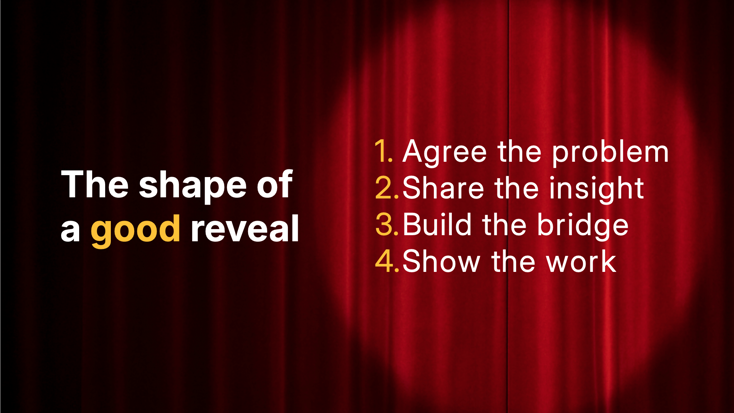
A reveal that lands has four parts, in this order: agree the problem, share the insight, build the bridge, then show the work. The first three are your rationale. The work comes last. Not because it's the least important, but because by the time it appears, the room knows what it's being asked to judge.
1. Agree the problem
Say the brief out loud. Not a line skimmed past in the deck. The problem, the audience, what success looks like. Then ask one question: is that still right? That way you've agreed what you're judging against before anything is on screen, and feedback can be held up against the brief, not against someone's taste. If the brief has changed, it's far better to find out now than once the work is on screen. Agree what has changed, then decide together whether the work still answers it.
2. Share the insight
This is the evidence your rationale stands on. What you know about the audience. What's happening in the market. And the choice you made because of it. Taste is easy to argue with. Anyone can say “I'm not sure it feels right.” Evidence is different. A line from a customer interview. A number from the data. Three competitors who all look the same. None of that is a matter of taste. Keep it to two or three points, each backed by something real.
3. Build the bridge
One sentence that joins the insight to the work: because you found this, you made that.
Because every competitor looks the same, you made them look different.
Because customers trust other customers, you built it around their words.
Because the press only calls when it goes wrong, you gave them something good to cover.
Same shape every time. It tells the client the idea didn't come from nowhere, and it gives the room a test: does this idea answer what we found? If you can't say it in one sentence, the thinking and the work haven't met yet.
4. Show the work.
That's the next section.
How long should the rationale be? Minutes, not the meeting. The client has been waiting to see the work, and every minute of rationale is a minute they're still waiting. The problem in a sentence. The insight in two or three points. The bridge in one line. Run too long and the thinking becomes the thing standing between them and the work. The rationale is there to make the work land, not to delay it.
How agencies should show the work
Before the work appears, agree how everyone will give feedback. Ask them to say what works and why, and what doesn't and why. That turns “I'm just not sure it feels right” into something you can act on. Fixing it is your team's job, not theirs.
Then say what you're asking the room to judge. The idea first. Then the form it takes. Mix the two and a headline, a colour or a layout becomes the whole conversation.
How many ideas should an agency show? At the early concept stage, when the client wants to choose a direction, two or three routes works well. It turns the question from “do I like this?” into “which of these answers our brief best?” Once an idea is developed, show one. Your recommendation. Present three developed ideas and you've handed the room a taste vote. The best argued idea loses to the one somebody likes the colour of.
What should an agency do once the work is on screen? Show it in context, where the client's audience will actually meet it, not on a flat white slide. Clients can't picture what they can't see. Then stop talking. The first silence feels long. It's fine. People are taking it in. Watch who speaks first, and who stays quiet. The quiet one is often the person who signs it off.
The instinct to fight is over-explaining. The client says something lukewarm, the silence feels unbearable, so you fill it with another reason, then another. Then you sound unsure of the idea yourself. Say it once. Then listen. On a video call, try “I'll leave that with you for a moment”, then wait. It feels odd. It works.
How to handle pushback in a client presentation
Pushback still comes, even with a well-built reveal. What you do in the next thirty seconds matters.
The temptation is to defend the work, or fold and say you'll take another look. Both make things worse. Go back to the thinking, and use questions.
What were you expecting to see? That tells you whether the brief and the room's expectations ever matched.
Which part of the brief does this miss? That moves the conversation off preference and onto the problem you agreed.
What would need to be true for you to say yes? That turns a reaction into a requirement.
Say the client tells you it feels too serious. Don't explain why it's right. Ask: “Too serious for whom? For the audience we agreed on, or for how you'd speak yourself?” You're not defending anything. You're getting curious about their reasoning, the same way you showed them yours.
Before anyone leaves, say back what you heard. The idea works. The tone needs to move closer to the brief. The pack needs legal sign-off. Then agree who does what, and by when. That shows you listened, stops three people leaving with three versions of the feedback, and gives you something to send afterwards that everyone has already agreed.
Then ask for the decision. Are we agreed on this direction? If they say yes, stop selling. Every extra reason is a chance to unsell it. Once it's agreed, write down what and why.
How to make sure the idea survives the internal meeting
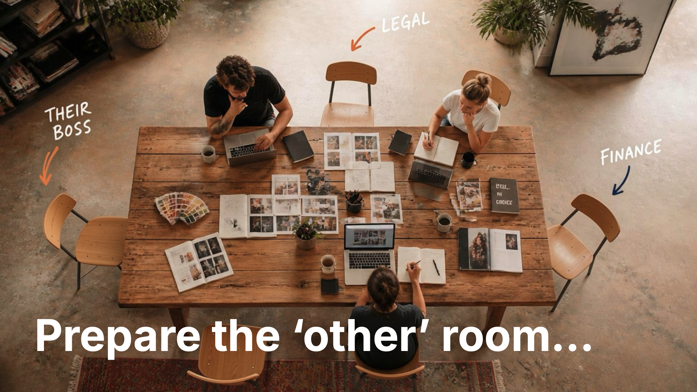
Ideas sold in the room can get unsold in the corridor. The second meeting, the one you're not in, is where the idea gets tested without you.
Your day-to-day contact might love the work. Then they take it to their boss, or legal, or another department. And the feedback comes back in three voices that contradict each other.
In that room, your contact is the one pitching your work. You won't be there. So can they?
Give them what they need to do it. The problem in a sentence. The insight in two or three points. The bridge in one line. If they can say that, the idea survives the journey.
Don't send the work on its own. Remember the opening of this guide: the thinking was in the email, and it never got read. If you have to send it, build the order into the file. The same four parts, in the same order. The thinking can't be skipped, and your contact has something to forward.
If your contact can't explain it without you, you don't have a bad reveal. You have an unfinished one. And you've found out while there's still time to fix it.
Here's the honest truth about everything in this guide. It isn't really about presenting.
The tactics are the easy bit. Agree the brief. Share the insight. Say the bridge in one sentence. You can start this week. What's harder is the shift underneath: most agencies lead with the work and leave the thinking in an email. The ones who get a yes, and keep it, turn that round.
That's not a presentation skill. It's a habit. Get it right, and feedback becomes something you can act on.
Want to see how Synergist helps agencies keep briefs, client insight and project notes in one place, so the thinking is there when it's time to present? Book a demo