

In this guide:
The project's done. The client's thrilled. Your team is already three projects deep into the next thing.
And here's what happens at most creative agencies: absolutely nothing. No debrief. No "what did we learn?" Just straight into the next fire.
Sound familiar?
Watch our agency experts break down how to get it right (20 mins)
Steve and Kate bring over 20 years of agency experience between them, as they walk through the proven strategies for post project reviews that actually works.
Prefer to read? Continue below for the complete guide.
Why most agencies skip post-project reviews (and what they're missing)
Let's be honest about project management realities. You're too busy. Or if something went wrong, you don't want to look at it. Didn't happen, right? No accountability required.
But here's what you're leaving on the table:
When things go well, that's your goldmine. That's your case study. Your testimonial. Your referral opportunity. Your perfect moment to ask "what else can we help with?" and upsell into other divisions. Success isn't just about delivery, it's about momentum.
When things don't go well, you need reviews even more. Because if you don't figure out what went wrong, you're going to repeat the same mistakes on the next project. And the one after that. Your problems become patterns.
Or maybe you're better than this. Maybe you schedule retrospectives. Everyone sits in a room, it gets awkward, someone passive-aggressively mentions that missed deadline, and you end up with a Google Doc titled "Lessons Learned Q3 2025" that nobody will ever open again.
Post-project reviews are where your project management processes actually improve. By systematically reviewing what worked and what didn't across multiple projects, you spot patterns in your timelines, resource allocation, and communication approaches. This lets you refine your project management methodology based on real evidence rather than guesswork.
The agencies with the best project management learn from every project and continuously refine their approach.
The post-project review process for agencies
Post-project reviews aren't just one meeting. They're a complete system. Here's how it works:
Before the meeting:
- Each team member individually completes their perspective on project learnings. No group think. No playing it safe. Just honest reflection.
- Your account manager reaches out to the client for feedback whilst it's fresh. You want their truth, not their politeness.
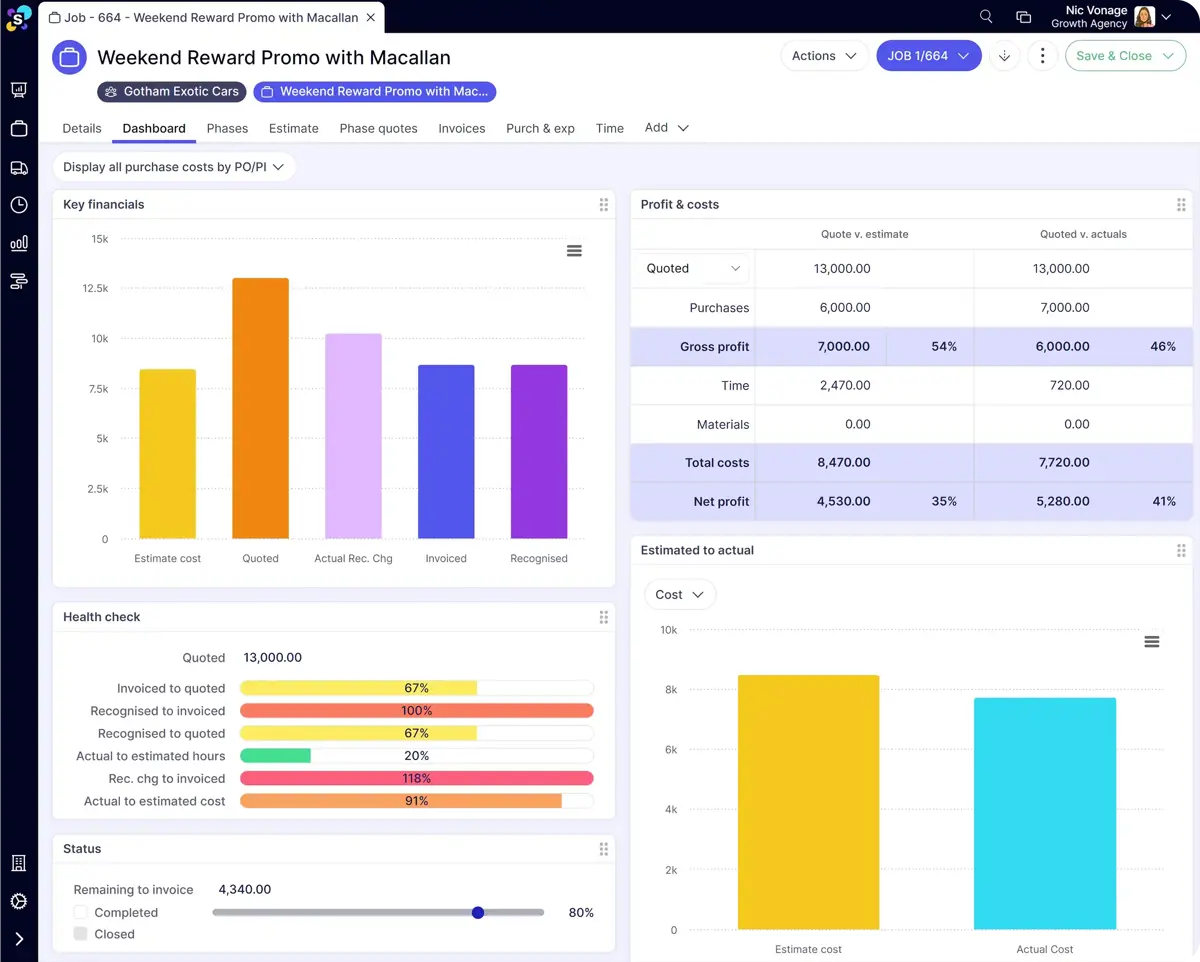
- And don't forget the numbers. If you use something like Synergist, look at estimated vs actuals. Quoted vs invoiced. Timeline performance. Client investment.
The review meeting:
- This is where everything comes together. The team discusses everyone's feedback, you layer in the client perspective, you extract the intel, and you agree on improvements. Real ones.
After the meeting:
- You document everything so it actually gets used. Not filed. Used.
Top tip: schedule the review before the project ends. Make it part of your close-out process. Non-negotiable calendar hold.
Now let's break down exactly how to do each piece.
Why timing matters in post-project reviews
First up: timing. 48 hours. That's your window.
Not immediately after project delivery. People are exhausted, emotions are high, and you're not going to get good insights when everyone just wants to sleep for three days.
But also not three weeks later. Because memories fade and people rationalise problems away. That disaster timeline becomes "a bit tight". That scope creep becomes "the client evolving their thinking". The sharp edges get smoothed over.
48 hours is the sweet spot. The adrenaline has worn off, but the details are still crisp. Your designer still remembers exactly why that third round of revisions happened. Your account manager still has the client conversation fresh in their mind.
Within 48 hours of project delivery, you send out the prep doc. This is where each team member individually completes their perspective on the project learnings.
This does two things. One, people have time to reflect and process, not just react. Two, they've already documented their thoughts, which means the review meeting is about discussion, not trying to remember what happened.
How to get honest client feedback that actually helps
Most agencies either skip client feedback entirely—they're already onto the next project, or they're afraid of what they might hear. Or they send a generic survey that gets ignored or returns responses like "everything was great, 5 stars!"
The agencies that consistently win repeat business aren't just good at the work. They're good at making clients feel heard.
Here's how smart agencies approach client feedback:
Tell them it's coming
Make it part of how you work. During client onboarding, say: "At the end of every project, we schedule a 15-minute debrief. It helps us get better, and it gives you a chance to tell us what's working."
Timing matters
You want to ask within a week of project delivery. Not immediately. Let them live with the work for a few days. But not months later, when they've moved on.
Don't send a survey. Have a conversation.
A 15-minute call or a coffee if they're local. You want dialogue, not data points. Say something like: "We're always looking to improve how we work. Would you have 15 minutes to debrief on the project?"
The client feedback questions that work
Here's your framework for agency project reviews:
Start with: "What part of this project exceeded your expectations?" This tells you what to emphasise with future clients and where your agency truly adds value.
Then ask: "If you were doing this project again, what would you change about how we worked together?" Notice the framing. Not "what did we do wrong" but "how would we work together differently." This invites honest feedback without making it feel like criticism.
Be direct: "What was the most frustrating part of the process?" Give them permission to be honest. And don't defend or explain when they answer. Just listen and ask follow-up questions. "Tell me more about that." "What would have been better?"
Get reflective: "What did you learn about your own team or process through this project?" This question is sneaky good. It gets them reflecting on their side of the equation, which often reveals hidden issues.
Close strong: "Would you work with us again, and why or why not?" Simple. Direct. And their answer tells you everything about whether you actually delivered value.
Ask for more: "What else can we help with?" "Are there other teams or divisions we should be talking to?" This is your upsell moment. This is your referral opportunity. When they're happy, ask.
What to do with client feedback
First, thank them genuinely. Tell them this helps you get better. Maybe even tell them one specific thing you'll change based on their input. That closes the loop and shows you're actually listening.
Second, document it immediately. Whilst you're still on the call, or right after. Capture direct quotes if you can. "Client said the timeline was aggressive, but we were responsive when things shifted" - that's useful. "Client was happy" - that's not.
Third, compare this feedback to your internal review. Sometimes what the client loved is different from what you thought went well. That gap is important. It might mean you're underselling certain strengths, or overvaluing things that don't matter to them.
Top tip: If the feedback is tough, resist the urge to get defensive with your team. This is learning, not blame. Sometimes clients are wrong or unreasonable, sure. But even unreasonable feedback tells you something about expectations management or communication.
Don't forget the numbers: How to review project performance
You can have brilliant insights about process improvements and client satisfaction, but if you're not looking at the numbers, you're only seeing half the picture. Financial reality keeps creative ambition honest. You can't afford to repeat unprofitable patterns, no matter how beautiful the work.
If you use agency project management software like Synergist, this is straightforward. If not, you'll need to pull this data manually. Either way, here's what you're looking for:
Estimated vs actual
This is your efficiency barometer. Did the project take 50 hours or 150 hours? If your estimate was wildly off, why? Was the scope different than expected? Did the client request more revisions? Did you underestimate the complexity? Or were there internal inefficiencies?
Look at this by phase. Maybe design came in under budget, but development went over. That's useful intel for scoping future projects.
Read our guide to estimating accurately and quoting profitably
Quote vs actual
What did you charge the client versus what did it actually cost you to deliver? This is your true profitability picture. You worked X hours but only billed for Y hours. The gap is money you left on the table.
Common reasons for the gap:
- Hours worked on scope creep that you didn't charge for
- Time you wrote off because you went over the fixed fee quote
- Additional services you threw in "to keep the client happy"
- Rework or corrections you absorbed instead of billing
- Internal inefficiency you chose not to pass to the client
Every hour between actual and invoiced is a decision someone made. Understand those decisions. Are they strategic (investing in a key client relationship) or accidental (poor scope management)?
If you consistently work 20% more hours than you bill, you're working one day a week for free. That's not sustainable.
Timeline performance
Did the project finish when you said it would? If you quoted 6 weeks and it took 10, that's not just a timeline problem, it's a resource allocation problem, a cash flow problem, and possibly a client relationship problem.
Look at what caused delays:
- Client feedback cycles
- Internal bottlenecks
- Scope changes
- Dependencies on third parties
- Unrealistic initial estimates
Understanding your timeline performance helps you quote more accurately and manage client expectations better.
Client investment
This is the big-picture view: across all projects with this client, are you over- or under-recovering against your profit targets?
If you use Synergist (or similar project management software), there's a powerful metric called "Client Investment." It's the difference between what the system recommends you should charge (based on actual time and costs) versus what you actually billed.
Positive number = You've billed less than recommended (under-recovered)
Negative number = You've billed more than recommended (over-recovered)
Let's say across all projects with Client X:
- Recommended charge (based on actual time + costs): £50,000
- What you actually billed: £42,000
- Client Investment: +£8,000 (you under-recovered by £8,000)
This means you've essentially "invested" £8,000 in this client relationship by billing less than you should have. That might be intentional (relationship building, strategic account) or accidental (poor value billing, too many write-offs, scope creep).
Read our guide to measuring client profitability
Profitability by segment
The real power comes when you analyse this across different dimensions:
- By client sector: Are financial services clients under-recovering while tech clients over-recover?
- By project size: Do small projects get squeezed while large ones are profitable?
- By service type: Is branding consistently under-recovered but web development healthy?
- By account manager: Is one person consistently under-billing or over-delivering?
This intelligence helps you make strategic decisions about what services to push, what to price differently, and where to improve your delivery.
Maybe you discover that mid-sized e-commerce projects for retail clients consistently over-recover (you're billing more than recommended because you're efficient). That's your sweet spot. Double down on that.
Want to make financial reviews easier? Project management software like Synergist automatically tracks estimated vs actual hours, recommended vs billed amounts, and client investment across all projects. Instead of manually pulling data from spreadsheets, you get instant visibility into what's actually making you money. Get a demo of Synergist to see how it works
Red flags in your financial review
Here are the warning signs that should trigger deeper investigation:
The project was "successful" but unprofitable
This is the creative agency trap. Beautiful work, happy client, but you lost money. This isn't sustainable. Figure out if it was a one-off investment or a systemic pricing problem.
Massive variance between estimate and actual
If you estimated 50 hours and it took 150, something went very wrong. Either your estimating process is broken, or the project scope changed dramatically without repricing. Learn how to improve project estimating
Consistent write-offs or unbilled time
If you're regularly writing off 10-20% of your time, you're subsidising your clients. That's not generosity, it's poor project management.
Timeline slippage on every project
If nothing ever finishes on time, you can't plan capacity, you can't forecast revenue, and you're probably frustrating clients even if they're polite about it.
High margin but unhappy client (or vice versa)
If you made great money but the client relationship is damaged, you've optimised the wrong thing. Similarly, if the client is thrilled but you lost money, you've got a different problem.
Financial performance isn't separate from project performance. It's an indicator of how well your processes work, how accurately you estimate, how effectively you manage scope, and how well you're serving your business alongside your clients.
Make it a non-negotiable part of every post-project review.
The project review meeting: structure that gets results
Who should attend the project review meeting?
You want a rep from each touchpoint on the project. Your account manager, your designer, your developer, your project manager, whoever had meaningful involvement. You're getting the complete picture, not just one perspective.
Right, let's talk about how to actually structure this conversation.
Here's the structure that works for creative agencies:
The Project Learning Framework
Quadrant 1: What worked that we should repeat?
This is your goldmine. Maybe your developer jumped into the kickoff meeting, and that completely changed the technical approach. Maybe sending the client work-in-progress updates instead of waiting for "final" versions built more trust. These are the things you want to systematise across your agency.
Quadrant 2: What didn't work that we should stop?
This is the problems section. But notice the framing: "stop doing" not "who screwed up." You're looking at processes, not people. Maybe your review process has too many stakeholders. Maybe your timeline template doesn't account for client holidays. These are structural issues.
Quadrant 3: What surprised us?
This is the learning section. Maybe the client cared way more about mobile than you expected. Maybe the project took half the time you estimated because the client was incredibly responsive. Surprises tell you where your assumptions are wrong.
Quadrant 4: What would we do differently next time?
This is your action items section. Specific, concrete changes. Not "communicate better"—that's useless. "Send the client a 5-minute Loom video after every major milestone" is actionable.
Spend 10 minutes per quadrant. Keep it focused. Keep it moving.
Creating psychological safety in agency review meetings
The biggest barrier to effective post-project reviews isn't logistics. It's psychology. People don't want to be honest in retrospectives because they're afraid. Afraid of looking incompetent. Afraid of throwing someone under the bus. Afraid of their boss getting defensive. Afraid of being blamed.
If you want honest feedback in your agency, you need to create psychological safety. Here's how:
Rule 1: No blame, only systems
You establish this upfront. "We're here to look at our processes, not to point fingers. If something went wrong, we're asking why our system allowed it to happen, not who messed up." This reframes the entire conversation.
Rule 2: Leader speaks last
If you're the agency owner or the ops manager, you talk last. Not first. Because if you start with your perspective, everyone else will just agree with you. You want unfiltered input.
Rule 3: Use language that creates distance
Instead of "what went wrong," try "What didn't work that we should stop?" It's the same question, but the framing makes it less personal for your team.
Rule 4: Separate observation from emotion
When someone says "the client was impossible," dig into that. "What specifically happened? What did they do?" You're looking for patterns, not venting. "The client requested changes after approval three times" is useful. "The client was difficult" isn't.
Rule 5: Ban the sandwich method
You know, "Here's something good, here's the criticism, here's something good again." It's condescending, and everyone sees through it. Just be direct. Adults can handle straight feedback if it's delivered with respect.
Top tip: Use the phrase "Help me understand" instead of "Why did you." "Help me understand what happened with that timeline" feels collaborative. "Why did you miss that deadline?" feels accusatory. Same information, totally different energy. The goal is to make the review feel like puzzle-solving, not a performance review. You're all on the same team, trying to figure out how to work better.
The improvement loop: turning insights into action
Right, so you've got pages of insights from your review. And now here's where most agencies fail: nothing happens. The insights die in a Google Doc. Everyone goes back to working exactly the same way.
The improvement loop is how you prevent that. Here's the system:
- Prioritise ruthlessly
You cannot fix everything. You shouldn't try. At the end of your review, ask: "If we could only change three things before the next similar project, what would they be?" Vote on it. Get consensus. - Make changes small and specific
Not "improve communication." That's not a change, that's a wish. Instead: "Add a 15-minute client check-in every Monday." - Assign an owner
Every change needs one person whose job it is to implement it. Not "the team will do better." One person. One name. They own it. - Set a test period
"We're trying this for the next two projects, then we'll evaluate." This does two things. It makes change feel less permanent and scary. And it gives you a clear moment to assess if it's actually working. - Close the loop
At the start of your next post-project review, begin by reviewing the changes you committed to last time. Did we do them? Did they work? This creates accountability and shows the team you actually change based on these conversations.
That's the improvement loop. Insights become actions, actions become habits, habits become your operations.
How to capture and share project learnings across your agency
Last piece: how do you capture all this so it's actually useful later?
- The Project Log
A simple shared spreadsheet or you could use AI to build a knowledge base. Match it to your Project Learning framework. One row per project. Columns for: client name, project type, repeat, stop, surprised, next time, process change.
Super simple. This lets you spot patterns across all your work. "Huh, we've had scope creep on four e-commerce projects in a row—maybe our e-commerce scoping process is broken." This is your "what are we learning across all our projects" system. - The Client Wiki
This is the client-specific intelligence. Create a simple wiki page for every major client. After each project, you add an entry with: what surprised us this time, how they've evolved, new stakeholders, updated preferences.
When someone on your team starts a new project with that client six months later, they read the last three entries. Takes 10 minutes to write. Saves hours of mistakes. This is your "getting smarter about this specific client" system. - The Playbook update
This is where insights become standard practice. After every review where you identify something that should become standard practice, you update the playbook. The playbook is alive. It evolves with every project. This is your "how we actually work now" system.
Top tip: documentation should take less than 15 minutes to create and less than 10 minutes to consume. If it takes longer than that, nobody will do it or use it.
The best documentation system is the one your team actually uses. Start simple. You can always add complexity later.
Because here's the truth: the agencies that win consistently aren't the most talented. They're the ones that learn faster than their competition. Every project makes them smarter, every review makes them better, and every lesson gets captured so they never make the same mistake twice.
Project review or regret. The choice is yours.
Book a demo
See why thousands of agencies - from design to digital, 10-500 people - choose Synergist to manage their operations more intelligently and profitably.