

In this guide:
Many agencies believe that they need to focus on new business to grow. But acquiring new clients costs money—think marketing, sales, pitches, procurement—and winning new business is getting tougher and taking longer in many cases.
Research shows that returning clients spend 67% more than new clients. (BIA Advisory)
New clients usually start with a "trial" project, spending conservatively while they build trust. On the other hand, existing clients who are familiar with your work, feel connected to your team, and have had a positive experience are more likely to invest more.
In this guide, we’ll focus on the role of agency account management, sometimes known as client services. The bridge between your agency and your client, what does this role actually entail, and how can you nail it to perfection?
What is agency account management?
Agency account management is the practice of building and growing client relationships to increase retention, satisfaction and profitability. For creative, marketing and digital agencies, it’s the bridge between client needs and agency delivery.
Agency account management involves cultivating client relationships and expanding accounts within an agency. It’s a customer-facing role that relies on understanding client needs and good communication and often crosses over into sales.
Essentially, account management is about the client relationship, keeping it fresh and active, coming up with new ideas, working on strategy and proactively growing the relationship.
Effective account management is vital for the growth of an agency. It helps prevent client turnover, removing the need to constantly seek new business. It reduces project delays and overservicing, leading to increased profit margins. It improves client satisfaction, ensuring repeat business and opening up opportunities for upselling and cross-selling. And it contributes to enhancing the reputation of your agency.
Client retention increases profits by 25–95% (Bain & Co)
The role of client services is often misunderstood and sometimes criticized both inside and outside the company. Historically, it hasn't even been considered a profession. However, when you consider their value in building relationships, safeguarding the agency's reputation, and overall involvement in the client experience from beginning to end, it's time to change perceptions.
What does an account manager do in a creative agency?
This role can vary between agencies, usually depending on their size. Larger agencies may have a separate project management and agency management function, while smaller ones may create more of a hybrid role spanning the two. While both work alongside creative teams to oversee projects, they each have a different focus.
Read more: What’s the difference between project management and account management?
The role is incredibly multifaceted - they do a lot! - meaning a good account manager has to be prepared to wear a lot of different hats. These can include:
- Understanding: they need to understand perfectly what your agency can deliver and what services are on offer, as this can help them cross-sell to clients – or, on the flip side, make sure they aren’t over-promising. If you have demonstrable proof, such as testimonials or case studies, this can help them give clients results-led information.
- Navigating: who needs to do what when? As the conduit between the client and creatives, the account manager needs to balance all elements of the project, keeping everyone fully informed to make sure it’s delivered on time and on budget.
- Listening: this is a huge part of the role. Essentially the account manager is making sure your clients are having their needs met, which means digging deep into their business and asking the right questions. Listening to the client will shed a lot of light on what they’re looking for, helping your agency to understand what makes them tick and any challenges they might come up against.
- Analysing: this tends to become more relevant in senior roles, which add a commercial and strategic aspect to the relationship. Here, they will spend a lot of time researching clients, following them on social media, and constantly monitoring not just the client’s activity but that of their competitors and the industry as a whole.
- Identifying: a good account manager doesn’t just take on briefs, they are proactive about coming up with new ideas and offering other services to complement those they’re already using. Identifying any potential pitfalls the client may face in the future can help them offer up opportunities for your agency to help navigate around these.
- Supporting: it’s always a good idea to train your account management team on the basics of how your finance function runs. While they don’t need to be experts, they do need to understand things like how not inputting a PO onto the system can impact profitability or how not sending a client invoice to finance in good time can make an unpleasant dent into cash flow.
Most common complaints about agency account management
While account management can be a real differentiator for agencies, it's also where things frequently go wrong.
85% of clients with a weaker or more vulnerable relationship with their agency cited client service issues as the main reason.
It's generally not the quality of work that makes or breaks client/agency relationships, but client service failings. These can impinge on client time and make the client's life more difficult, and eventually become evidence that the agency is 'not listening'. (Up to the light)
Most common complaints about agency account management:
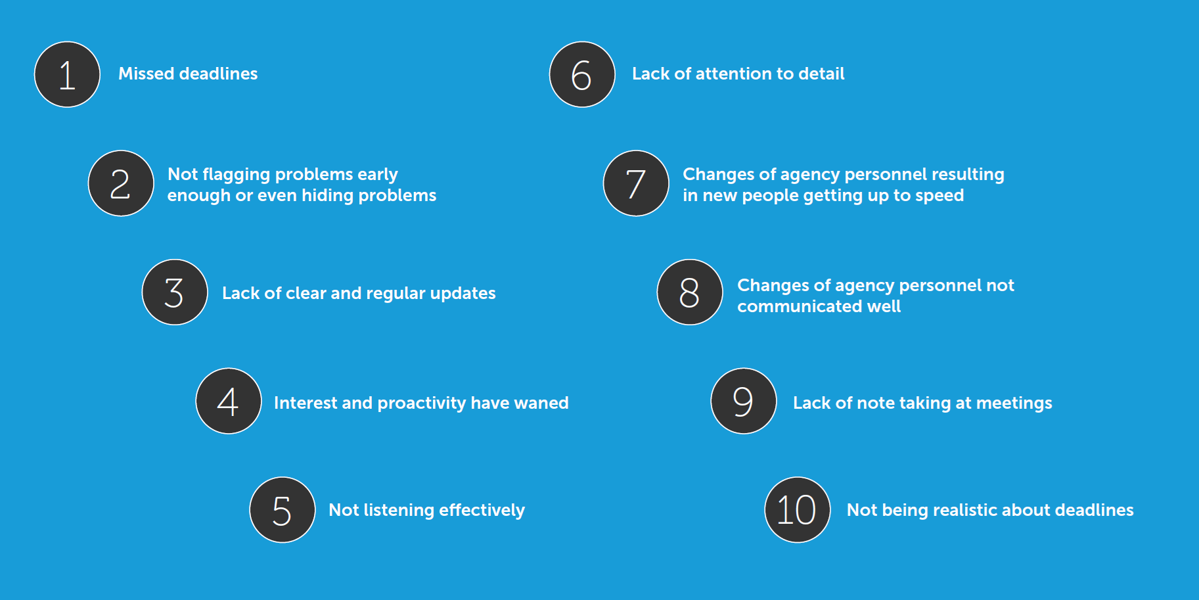
From 'What clients think 2025' by 'Up to the light'
The most frequent complaints fall into several key areas.
Communication breakdowns top the list, with clients citing lack of clear and regular updates, poor listening skills, and inadequate note-taking during meetings. When clients feel they're not being heard or kept in the loop, relationships quickly deteriorate.
Project management failures are equally damaging. Missed deadlines and unrealistic timescales create stress and erode trust, while not flagging problems early enough – or worse, actively hiding them – can turn minor issues into major crises. Clients want transparency, not nasty surprises.
Declining engagement is another red flag. When account managers lose interest or become less proactive over time, clients notice immediately. What starts as an enthusiastic partnership can gradually become a transactional relationship where the account manager is simply going through the motions.
People and process issues also feature heavily in client complaints. Changes in agency personnel that aren't communicated well, or new team members who take too long to get up to speed, can disrupt established relationships and create frustration on both sides.
The common thread running through all these complaints is that they're entirely avoidable with the right approach and mindset.
Essential skills of a great agency account manager
The role involves a lot: plate spinning, relationship building, communication, project management and more.
45% of clients believe that their agency account management is too transactional. The most mentioned missing ingredients are proactivity, ability to see the bigger picture, adding value over and above simply carrying out client requests. (Up to the light)
With this in mind, the best account managers are:
- Enthusiastic. It’s a people-facing role and they are representing your agency, so being downbeat is a no-no. And it’s not just about pasting on a smile. It’s about being sincerely interested, about truly listening and about nurturing relationships so that clients feel they are genuinely important to your agency.
- Organised. Having their ducks in a row at all times will give clients confidence they’re dealing with professionals who can be relied on. Being on time for meetings, keeping clients updated, always returning messages never needing prodding or chasing up can all add up to happy clients.
- Honest. Mistakes happen but covering them up simply doesn’t work. Account managers need to own any mistakes from the agency, being upfront with clients and, crucially, always explaining how these will be rectified.
- Confident. This can mean making sure teams aren’t slipping with deadlines, challenging areas of the brief and not being afraid to take charge, making sure projects all run smoothly and on time.
- Proactive. Going beyond the brief, looking at strategic and commercial aspects, suggesting other added-value services and taking full ownership of projects will take pressure off clients, giving them confidence they don’t need to be constantly monitoring project status.
- Strategic. Great account managers don't just execute tasks, they understand how each project aligns with the client's broader business objectives. They can connect the dots between different initiatives, anticipate future needs, and provide insights that help clients achieve their long-term goals rather than just completing individual deliverables.
How strong agency-client relationships drive growth
Ultimately, the type of chemistry you have with your clients can make the difference between keeping the work flowing and sending them somewhere else. It’s not just about giving them quality work, but about making them feel valued and important.
Which means going the extra mile. Not just meeting expectations but exceeding them. And good account management plays a pivotal role here.
Here’s how they can cultivate and strengthen client relationships:
- Being responsive. One of the major things to erode trust is a slow response in replying to emails, not providing costs when asked, and always asking for more time to complete tasks. For clients, this can seem like evidence that agencies are over-stretched and under-resourced.
- Staying on time and budget. Jobs going over are effectively a breach of trust, delays and cost overruns can be very frustrating to clients.
- Paying attention to detail. Errors and lack of quality control lead to loss of trust in your agency’s capability and credibility.
- Staying proactive. Passive account management is not acceptable. It’s about chasing and challenging, reaching out, and always being on top of everything.
- Understanding the business. This means what it says but also encompasses wider elements, such as this industry landscape, target audiences, brand identity values, market trends and regulatory requirements. Account managers also need a good understanding of client growth plans, so you can tailor your agency’s strategies to support these objectives.
- Knowing when to say no. If account managers say yes simply to be a client pleaser then the outcome is likely to be the opposite. Far better to explain that you can schedule in work, or signpost them elsewhere if you don’t offer the required services, to show you have their genuine best interests at heart.
How to create an agency account plan
You know the saying, ‘Fail to plan, plan to fail.’ When it comes to managing agency clients, it’s super important to create a plan on how you’re going to develop their account and then actually act on it.
These personalised plans can include things like targeted marketing strategies, specialised services, and regular check-ins to make sure you’re on track. Ultimately, taking the time to create a bespoke plan will strengthen your relationship with your clients and help you drive better results for your agency.
The general agency rule is to focus on growing your most profitable clients, as this will give you a greater return. So, the first step is to identify who is boosting the agency’s profit margins – How to calculate client profitability – then you can decide which clients to focus on (and which ‘vampire’ clients you might need to ditch!)
Your plan should include:
- A data deep dive
Getting to really know the spending habits of each client can help you decide where to set your targets. The first place to start is a review of previous spending – how have they spent in the past and on what type of work/services? And was some of that spend a one-off, such as for a big rebrand, or are there trends you can spot, such as exhibiting at a big event every two years?
Which agency services haven’t they used? Are there opportunities to cross-sell or bundle services together to upsell?
If they are increasing spend, why is this? Is it simply budgetary changes or are they getting just what they need from your agency? On the flip side, reduced spend could also be for internal reasons, or are they seeking other services that your agency isn’t providing?
How does the revenue and service mix differ across divisions if you're working with a multi-division client? - A client review
Clients change and evolve all the time, so it’s a good idea to carry out a review with them. Have they got new people or products you’re not aware of? Ask them about their strategic objectives, plans and challenges, and how you can help do more to help them succeed. Now is also a good time to ask them to evaluate your services: are you fulfilling all their needs, or is there something you could be doing better? - A market review
Some sectors or services may have higher growth potential than others, and understanding this can aid your target setting. Explore the overall market growth rate and demand for creative services – are clients likely to be investing more or less in certain services this year? Are there any areas of marketing competitors winning? Are these other services you could tap into?
Roles and career paths in an agency client services team
Depending on the size of your agency, a client services team can include a range of roles from entry-level account executives through to directors sitting on the board.
Each step up brings new responsibilities, greater client influence, and increasing financial accountability. Early roles are focused on admin and delivery support, mid-level roles balance relationships with profitability, and senior roles take on strategy, financial targets and leadership.
Here’s how these roles typically progress:
Account Executive
The entry-level role in client services. They support day-to-day project admin and client activities, taking instructions from account managers. Their focus is task delivery.
Senior Account Executive
With more experience, typically around a year, senior account executives manage small projects. They take briefs, create estimates, draft project plans, and begin to critically evaluate creative work - with some supervision. They take responsibility for controlling budgets on their own projects and start to build awareness of how overservicing and missed deadlines can affect client satisfaction and profitability.
Account Manager
Often with 2+ years’ experience, account managers are seen as a “safe pair of hands.” They manage client accounts and serve as the primary point of contact for their clients on a day-to-day basis. They manage projects from briefing to financials to ensure efficiency and profitability, while spotting opportunities for upselling and cross-selling. Depending on the agency structure, they may sometimes manage account executives or senior account executives.
Senior Account Manager
Usually with 4+ years’ experience (at least two at AM level). They are fully competent at managing the account(s) day-to-day – with comprehensive knowledge of all aspects of every job – but they’re starting to shift from implementer to a more strategic role. They attend client planning meetings, provide market insights, proactively suggest ideas, and work to advance client accounts. They take a more active role in forecasting and identifying opportunities for account growth and development.
Account Director
With 5+ years’ experience, account directors are responsible for ensuring client satisfaction, profitability, and account growth. They provide strategic input, sign off on projects, and oversee performance. Strong on financials, they forecast revenue and costs, and actively pursue upsell opportunities to meet targets. They often join new business pitches and are expected to present the agency confidently. In addition to managing the team's day-to-day operations, they also oversee their team’s performance, collecting feedback, setting objectives, providing regular coaching, and addressing any issues that arise.
Senior Account Director
With 7+ years’ experience, senior account directors focus heavily on client profitability, retention and development. They work with senior client stakeholders, often across multiple divisions, and contribute to business development. Their remit is broader, balancing client strategy with agency commercial targets.
Group Account Director
Typically with 9+ years’ experience, group account directors lead a portfolio of accounts. They manage procurement relationships, deliver account development plans, and oversee client-agency reviews. Financially, they are accountable for hitting annual revenue and profit targets across their group, while ensuring the full utilisation of the agency’s skills. They also lead their team’s development, implementing a structure that leverages everyone's strengths and encourages personal growth.
Client Services Director
A board-level role with 10+ years’ experience, responsible for overall client strategy, satisfaction, retention and growth. They shape client service processes, mentor the client services team, and hold accountability for agency-wide revenue and profitability. Additionally, they collaborate with other areas of the agency, such as HR to address any team issues and improve culture, operations to develop systems and processes, and finance to develop reporting and measurement.
Here’s how the main client services roles typically compare at a glance:
While every agency may title or structure these roles slightly differently, the progression is clear: as people move up the client services ladder, their responsibility shifts from task delivery to strategic growth and financial accountability. A well-structured team is one of the biggest drivers of client retention, satisfaction and long-term profitability.
The best KPIs to measure agency account management success
Key performance indicators (KPIs) are a clear way to measure success, progress and challenges within your agency’s account management function. But what are the most effective things to track?
- Value. What tangible value are your account managers providing to your clients? Are they passively taking and passing on briefs, or are they strategically and proactively putting the client's interests centre stage? The more they add value to clients, the more they add value to your agency in turn.
- Satisfaction. Are your clients happy with what they're getting from their account manager? Surveys are usually the best way to establish the answer to this, with the 'Net Promoter Score' (how likely the client is to recommend you) a popular methodology. Also, asking for feedback at a project and account level on a regular basis will identify key areas for improvement.
- Outcomes. Your account managers should be helping clients reach their project goals. Tracking project performance or asking your client for the result lets you see what progress has been made in helping clients achieve success – and address any issues promptly.
- Interaction. How much time do your account managers spend with their customers? You should really be looking for continual contact and consistent communication to keep relationships strong and relevant.
- Growth. It can be easy to sink into a transactional relationship where account managers are simply taking orders. Checking how your account managers are contributing to client growth will determine where business development training and support are needed.
- Referrals generated. Are your clients recommending your agency to others within their professional circle? You can find this out by asking directly or via surveys, checking if they're mentioning you on their social media, and asking potential new clients how they heard of you (e.g., word of mouth).
Agency account management FAQs
What is agency account management?
Agency account management is the practice of building and growing client relationships to increase retention, satisfaction and profitability in a creative, marketing or digital agency.
What does an account manager do in an agency?
An account manager is the bridge between clients and delivery teams. They manage communication, scope and expectations, surface upsell/cross-sell opportunities, and help ensure projects meet client goals.
What are the best KPIs for agency account management?
Common KPIs include client retention rate, Net Promoter Score (NPS), revenue per client, upsell/cross-sell ratio, referrals generated and average client tenure.
How is account management different from project management?
Project management focuses on delivering work on time and on budget. Account management focuses on long-term relationships, commercial growth and client satisfaction.
How do you create an agency account plan?
Start with a data deep dive (spend, services, trends), run a client review (objectives, gaps), add a market review (growth areas), then set account goals with regular check-ins.
Strong account management is the foundation of agency growth. Want to see how Synergist helps leading agencies manage client relationships and profitability?