

You started your agency with a simple dream: brilliant work, brilliant people, decent money. Fast forward a few years and you're drowning in timesheets, worrying about payroll, and wondering where that creative spark went. Sound familiar?
Here's the thing: agency growth follows a pattern. The Greiner Curve maps out six distinct phases, each with its own stability period followed by a crisis. Yes, crisis. Let's not sugarcoat it. These are genuine make-or-break moments that determine whether you evolve or implode.
Understanding these phases isn't just academic exercise. It's your roadmap for navigating growth without losing your mind, your clients, or that original passion that got you started.
Phase 1: Growth through creativity (The startup phase)
Typical size: 1-10 people
Remember those early days? Everyone wearing multiple hats, chaos feeling energising rather than exhausting. You're fuelled by creative energy and the absolute conviction that you're different. That you'll stay small and creative forever.
The reality? You're hands-on creatives with fluid, informal leadership. Ad hoc decisions rule the day. It's exhilarating until it isn't.
Your crisis: Leadership. Without clear structure, founders are stretched impossibly thin. Delivery becomes inconsistent. Your team starts craving the one thing you swore you'd never impose: direction and stability.
What you need to do:
- Formalise leadership roles (someone needs to own creative, someone needs to own operations)
- Set actual processes for delivery and client management
- Introduce project management and basic financial systems
- Start planning your tech stack upgrade. Those spreadsheets and Trello boards? They're about to break. When you hit 10+ people, you'll need proper agency management systems
Phase 2: Growth through direction (The emerging agency)
Typical size: 10-30 people
You've grown up. You're a "real agency" now. Processes exist. Roles are defined. If you've done Phase 1 properly, you've already upgraded from spreadsheets to a proper agency management system. (If you haven't, you're discovering why that was a mistake as projects multiply, reporting gets messy, and you can no longer "just know" what's happening.)
Here's the rub: founders feel the pressure to manage rather than create. Middle managers emerge. Client profitability and resource utilisation have become critical metrics, not nice-to-haves. You're hiring specialists who need shared visibility. Project overruns aren't just frustrating anymore; they're expensive.
Your crisis: Autonomy. Founders can't let go. They've become bottlenecks. Teams feel micromanaged, decisions crawl, and that creative spark you were so proud of? It's being slowly suffocated by management.
What you need to do:
- Empower team leads to actually make decisions
- Create clear accountability (by client, discipline, or pod structure)
- Let founders focus on strategic growth and culture, not daily operations
- Ensure your systems talk to each other. Siloed tools create siloed teams
- Consider senior hires: Client Services Director, Head of Strategy, people who can own big chunks of the business
Phase 3: Growth through delegation (The scaling agency)
Typical size: 30-80 people
You've built something substantial. Established client base, structured teams. But founders feel increasingly removed from the creative pulse. Middle managers want autonomy but lack clarity. Success feels... complicated.
Your crisis: Control. Too many independent silos operating without coordination. Delivery standards vary wildly. Communication between teams? What communication between teams?
What you need to do:
- Introduce proper coordination mechanisms (cross-functional leads, shared tools, blessed templates)
- Clarify goals and KPIs at both company and department levels
- Invest in proper leadership: HR, finance, operations
- Use systems and culture to maintain cohesion, not just hope for the best
Phase 4: Growth through coordination (The mature agency)
Typical size: 80-200 people
Highly professional. Possibly part of a network. Also possibly dying inside. Bureaucracy's crept in like damp. Too many meetings about meetings. Creativity feels constrained by "process" (and yes, those are bitter air quotes).
Leadership wrestles with an impossible balance: efficiency versus innovation. Senior managers spend their days managing, not leading. The energy's gone.
Your crisis: Red tape.Overly rigid systems have strangled flexibility. Your best talent is eyeing the exit because creative freedom's become a distant memory.
What you need to do:
- Simplify processes; trust your experienced people
- Invest in genuine cross-department collaboration
- Create space for experimentation: internal labs, R&D, something
- Foster a culture of collaboration, not compliance (there's a massive difference)
Phase 5: Growth through collaboration (The networked agency)
Typical size: 200+ people or multiple offices
"We're too big to feel small." That's your leadership team's lament. Culture's fragmenting across teams and offices. The creative edge that defined you? Diluted by scale. Innovation's slowing. Leadership's burning out.
Your crisis: Growth fatigue. New growth feels uninspiring. The excitement's gone. You're successful but somehow that's not enough anymore.
What you need to do:
- Reignite your purpose and brand DNA
- Build collaborative leadership models: matrix structures, genuine partnerships
- Explore acquisitions, alliances, or spin-offs
- Double down on internal culture and values-based leadership
Phase 6: Growth through alliances (The evolutionary phase)
Typical size: 300+ / multi-office / international
"How do we stay relevant?" That's the question keeping your C-suite awake. Competition's global. Agility's a distant memory. Younger agencies run circles around you. You're an institution, but is that a compliment or a curse?
Your challenge: Maintaining identity and agility within a large ecosystem. Integration across geographies and specialities feels like herding cats. With jetlag.
What you need to do:
- Form alliances with tech partners, boutique agencies, freelance networks
- Shift from hierarchy to ecosystems
- Stop trying to do everything internally
- Accept that your role might be platform, not player
The reality check
So, which phase are you in? And here's the real question: are you brave enough to do what's needed to reach the next one?
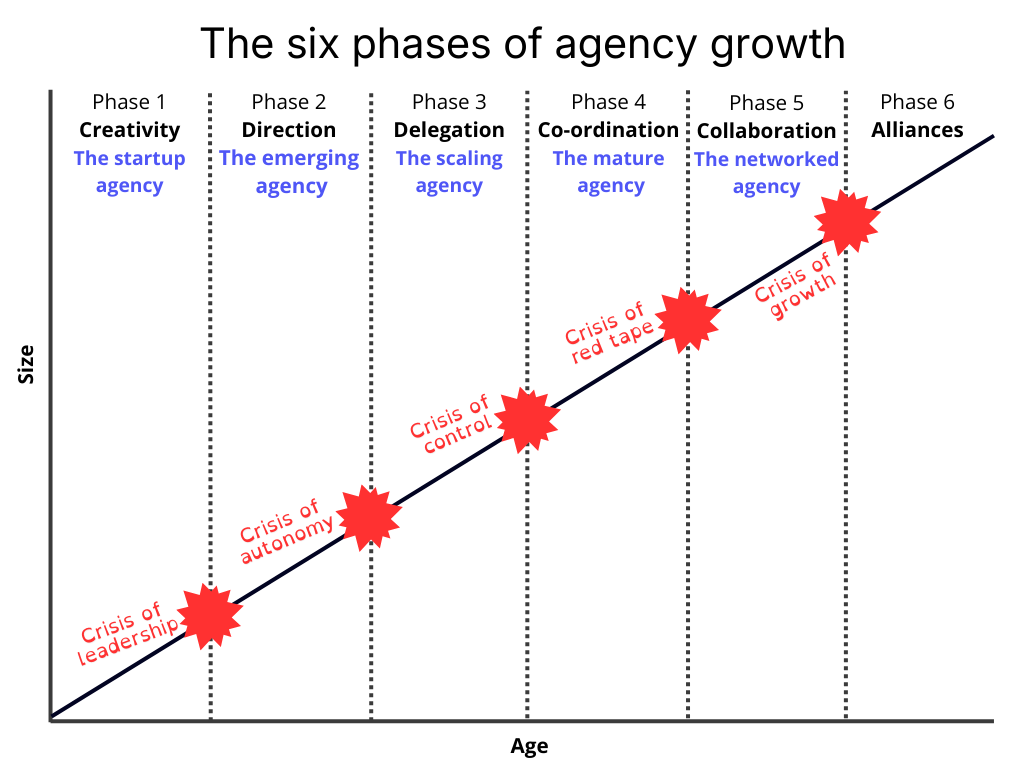
Some agencies stay stuck in Phase 1 for a decade, "by choice". Others sprint through phases like they're speed-dating stability. Duration doesn't matter. Recognition does. When you know where you are, you can plan where you're going. When you spot your crisis approaching, you can prepare rather than panic.
Each crisis is predictable. That's both the good news and the bad news. Good because you can prepare. Bad because knowing it's coming doesn't make it easier.
Your action plan
- Get honest about your current phase. The size and age guidelines are just that: guidelines. What matters is what you're experiencing
- Identify your looming crisis. Which challenge resonates? That's your next hurdle
- Start planning now. What changes will you need? Who needs to be involved? What sacred cows need slaughtering?
- Set a timeline. Crisis doesn't improve with age
- Prepare your team. Change is easier when everyone understands the why
Remember: every agency wants to preserve that Phase 1 creative magic. But preservation isn't the answer. Evolution is. Growth doesn't mean sacrificing what made you special. It means building structures that let your specialness scale.
The agencies that thrive aren't the ones that avoid these crises. They're the ones that see them coming and use them as catalysts for reinvention.