

In this guide:
To stay profitable, agencies need to ride out the inevitable peaks and troughs and keep teams fully utilised.
In this guide, we’ll walk through our best practices to help you keep your resourcing on track and plan capacity with confidence.
What is agency capacity planning?
Agency capacity planning is the process of understanding how much resource capacity you need to effectively meet your current and forecasted client workload.
In other words, it’s knowing how many people – and which skills – you need to deliver client projects and retainers without overwhelming your team.
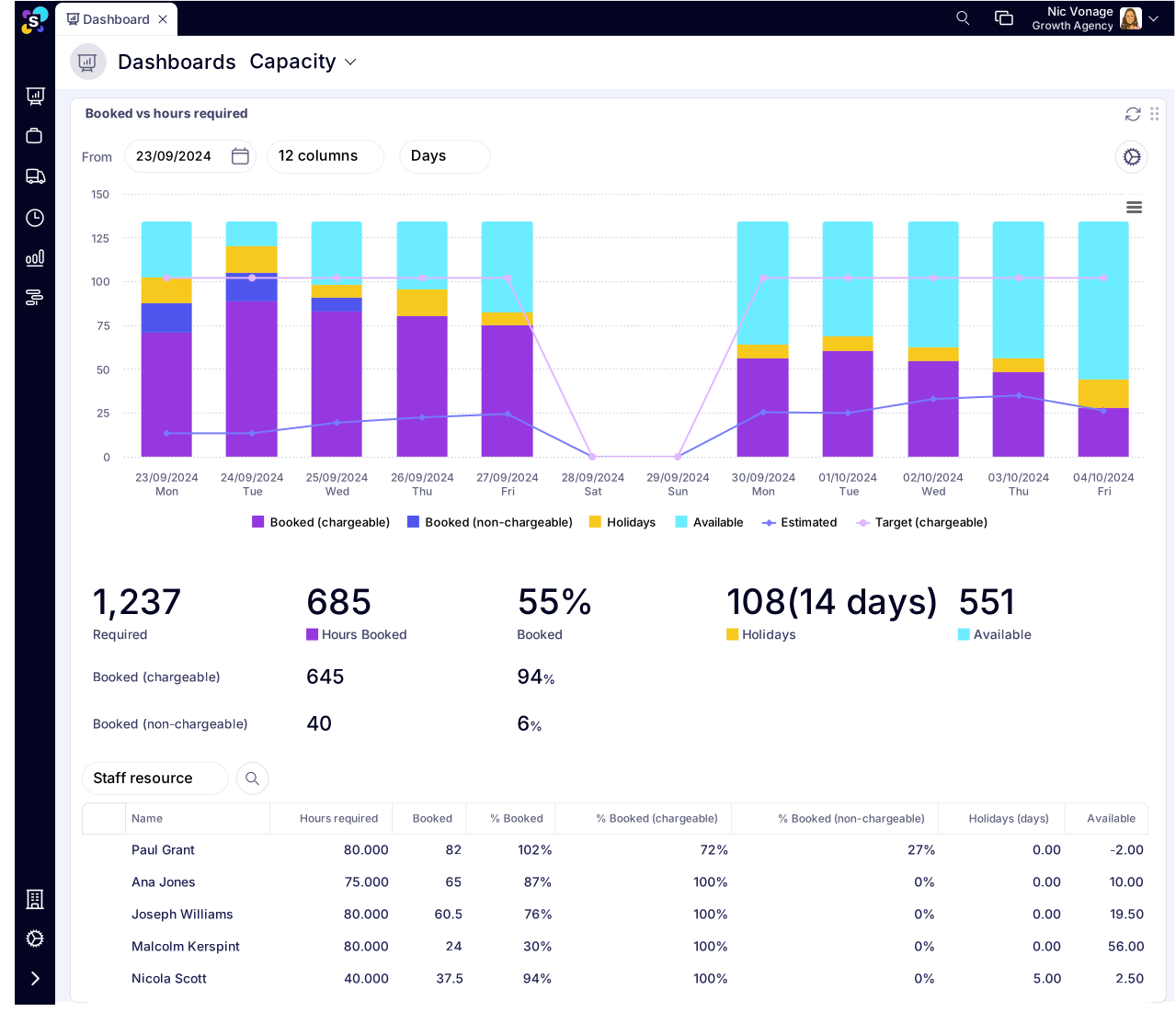 Synergist Scheduling Dashboard shows your team's capacity over the coming days, weeks and months
Agency capacity planning challenges
In practice, capacity planning is rarely straightforward for agencies, where workloads and priorities change constantly.
Let’s start by looking at six common challenges agencies face. Get on top of these and you’ll be in a stronger position to deliver high-quality work on time and within budget.
Selling too much (or too little) of each skillset
Your teams each bring unique skills. If you’re experiencing a quiet time, it can be tempting to take any work that comes your way. But if you’re simply making already-busy people even busier, you’ll end up with burnout in some teams and boredom in others.
In an ideal world, all your creatives will be working on chargeable work as much as possible. So if you’re constantly finding an imbalance between your teams’ workload, it could be worth taking a closer look at whether your agency has the right skills mix.
Projects dropping out or being delayed
Do you have a backup plan to keep people productive and prevent capacity gaps? Some agencies have a ‘pool’ of non-urgent internal work for creatives to dip into, or training they can dip into if a job doesn’t come in as planned.
Projects being squeezed in
Taking on too many projects is not good for anybody. You might want to snap them up before your competitors or avoid being seen to turn down work. But if you haven’t planned for this, your clients will end up with a rush job that won’t do your reputation (or your bank balance) any favours.
Over-servicing or underestimating, leading to work running over time
When people feel pressure to hit a utilisation target, they may be tempted to stretch tasks out to ‘look busy’. Make sure they know they won’t be penalised if there isn’t enough chargeable work available, because inflating hours only pushes jobs over budget and makes future estimating less accurate.
Underestimating has a similar impact. Make sure account managers do their due diligence: review previous work, speak with the creatives, and have a clear strategy for how many sets of amends are included.
Managing client expectations is crucial, too. Try to avoid reverse-engineering estimates just to match a client’s budget. You might choose to do that for quoting purposes, but your internal systems must still reflect the true effort required to deliver the work.
Overbooking or underbooking people
This is where managing your pipeline can be invaluable, so you know what’s coming in. You might know there are opportunities out there, but drilling down into when they might land, who needs to work on them and the scope of the project can help you avoid sudden capacity crunches.
Lack of forecasting
This is where managing your pipeline can be invaluable, so you know what’s coming in. You might know there are opportunities out there, but drilling down into when they might land, who needs to work on them and the scope of the project can help you avoid sudden capacity crunches.
The benefits of effective capacity planning for agencies
Effective capacity planning delivers benefits across your agency, from happier teams to healthier profits. Some of the biggest advantages include:
Clear visibility of available capacity
Knowing how much capacity and which skillsets you have available means you can forecast revenue accurately based on your current resources. You’ll use your existing teams to best effect, keeping everyone productive without creating overcapacity in any area. In short, it’s about matching workload to availability.
Optimised utilisation rates
Understanding each person’s true capacity helps you keep people busy without overworking them. This balance is key: agencies are naturally busy places, but when this tips over into becoming consistently stressful, you’ll find people are less motivated.
Smarter, data-driven resourcing decisions
Accurate capacity data lets you predict whether you’ll need to hire short-term freelancers, medium-term contractors or long-term recruits to meet extra demand. It also helps you spot potential gaps in workload early, so you can sell more work or even make informed decisions to reduce staff.
The ability to track and anticipate trends
Monitoring capacity over time reveals recurring patterns in workload and demand. For example, you might notice regular slow periods or clusters of holiday absences and can plan around them proactively.
Greater efficiency across projects
Good capacity planning improves estimating, resource allocation and workflow management. So you get to remove or reduce bottlenecks, reworks and idle time.
Happier clients and better relationships
Having the right people available at the right time means projects are delivered smoothly and to a high standard, helping you build trust and strengthen client relationships.
Improved profitability
When you’re properly resourced, and no one is being over- or underworked, you’ll be working at maximum efficiency. This translates into stronger profit margins, happier clients and a healthier agency overall.
How to do agency capacity planning
To plan capacity effectively, start by understanding how much time your team truly has available for client work – not just their total contracted hours.
Step 1: Calculate available working hours
At first glance, the formula seems simple:
Capacity = Working hours x number of people
Unfortunately, agencies aren’t as simple as that! Not every hour of the working day will be chargeable. Breaks, meetings, admin, new business, and internal projects all reduce billable time. These non-chargeable hours vary by team and individual, depending on their role and workload.
To see the true picture, we need to make our simple formula a little more sophisticated to calculate each person’s actual chargeable time.
Step 2: Calculate each team member’s utilisation rate
Your utilisation rate shows what percentage of someone’s working hours are available for chargeable client work. It’s the foundation of accurate agency capacity planning.
Utilisation rate = chargable hours / Working hours
You can’t realistically apply the same utilisation rate to everyone, as workloads, roles, and project types all differ.
To get the most accurate calculation, we recommend this four-step process:
- Talk to every team member and ask how much time they generally spend on non-chargeable work like meetings, admin or pitches. Patterns will often emerge across roles.
- Review the data. Look back over the past 12 months of timesheets to see real utilisation levels (assuming they’ve been filled in accurately, of course). A longer timeframe gives a truer picture.
- Consider your plans for the year. Will internal projects, training, or new business activity reduce client-chargeable hours for some people?
- Map an average week or month. Deduct the non-billable hours from total hours to get your final number of chargeable hours. You can then convert this into a percentage – that’s their individual utilisation rate.
Utilisation rate calculation example
A designer working 37.5 hours per week, with 30 chargeable hours, has an 80% utilisation rate. That percentage becomes the base figure you’ll use for capacity calculations.
|
Weekly tasks |
Time breakdown |
|
Admin |
3 |
|
New business |
0 |
|
Meetings |
0 |
|
Staff development |
2.5 |
|
Training |
1 |
|
Total internal time |
7.5 |
|
Utilised time |
30 |
|
Total time |
37.5 |
|
Chargeable % |
80% |
|
Non-chargeable time |
20% |
Read how ArmstrongB2B agency improved utilisation rates with Synergist
Step 3: Calculate each resource’s capacity
Once you know everyone’s utilisation rate, you can calculate their total monthly or weekly capacity using this formula:
Resource capacity = individual’s working hours × individual’s utilisation rate
When working out working hours, remember to exclude annual leave and bank holidays. For example:
260 workable days per year (52 weeks × 5 days) - (8 public holidays + 20 days’ holiday) = 232 working days per year x 7.5 hours = 1,740 working hours per year.
Divide by 12 for monthly hours or 52 for weekly hours
You can then combine capacity across skillsets. For example, if you have four copywriters, each with 100 chargeable hours per month, that’s 400 hours in total. Or roughly £30,000 of sellable time at £75 per hour.
You can also calculate your agency’s overall capacity by adding the individual capacity of everyone in a billable role.
Forecast capacity and resource demands
Once you understand your current capacity, you can compare it with your pipeline.
While work coming into agencies is never an exact science, forecasting is still useful – it helps you spot resourcing gaps and make proactive decisions about hiring, workload and scheduling.
Step 1: Review your live projects
Start with what’s already on your books. Look at each active project and calculate how much time remains to complete it.
Step 2: Assess your pipeline
Next, look at what’s coming up in your pipeline. Ask:
• When is each project expected to start and finish?
• Which roles and skills will be needed?
• How many hours or days are likely required for each person?
This shows you how future work will impact availability, plus whether you’ll have enough resource to deliver it all on time.
Step 3: Factor in new business opportunities
Finally, look to your new business. This is harder to predict, but you can use educated guesswork by looking at patterns in past data. Review previous months or years to see:
• How many new projects typically come in
• Which services or skills were most in demand
• How long it takes for opportunities to turn into confirmed work
From here, you can look at current and estimated capacity and make sure you have the right resources in place.
Step 4: Compare forecasted demand with available capacity
Now you can bring it all together by lining up your projected workload against your current capacity.
This shows where you have spare capacity you need to fill with new work, or risk being overstretched and may need to hire, outsource or delay projects.
By monitoring this regularly, you’ll always know whether your agency is resourced to meet demand, meaning you can make confident, informed decisions rather than last-minute fixes.
Example: If your design team has 400 chargeable hours available next month but your combined project and pipeline forecast requires 480 hours, you’re short by 80 hours. That means you’ll either need to hire a freelancer, extend deadlines, or shift internal priorities to keep projects on track.
Choose your capacity planning strategy
Once you’ve forecasted your workload, the next step is to decide how to meet that demand.
Agencies use three main capacity planning strategies, each with its own pros and cons.
|
Strategy |
How it works |
Pros |
Cons |
Best for... |
|
Lead capacity strategy |
You adjust capacity ahead of demand based on growth forecasts. |
You’re always ready for new work, giving you a competitive edge. |
If forecasts are off, you could overhire or have underused capacity. |
Fast-growing agencies confident in their forecasting. |
|
Lag capacity strategy |
You wait until your team is fully booked before adding capacity. |
Avoids unnecessary costs and keeps utilisation high. |
|
Smaller agencies prioritising cost control and flexibility. |
|
Match capacity strategy |
You adjust capacity gradually in line with forecasted demand. |
Balances readiness with cost control and avoids last-minute panic hires. |
Relies on accurate forecasting and consistent pipeline visibility. |
Agencies with steady pipelines and data-driven forecasting. |
Choosing the right approach
Many agencies use a mix of strategies depending on project type and business goals.
- Lead capacity strategy works best when growth is predictable and you can confidently plan ahead.
- Lag capacity strategy is ideal when you need to stay agile and minimise risk.
- Match capacity strategy is the most balanced approach and generally the most effective for agencies with good forecasting data.
Match capacity planning tends to be the most effective, as it keeps you agile while controlling costs – but it relies on accurate estimating and forecasting. Tools like Synergist make it easier by letting you track current capacity and future resource requirements across teams, skill sets, and individuals.
Recap: the agency capacity planning process
To summarise the process:
- Calculate each team member’s utilisation rate.
- Use this to establish each team’s capacity.
- Forecast demand and new business.
- Choose your capacity planning strategy to bridge any resource gaps.
Agency capacity planning software
Specialist software can automate agency capacity management, helping you effectively forecast, manage and report on resourcing.
When choosing an agency capacity planning tool, look for software that:
- Combines scheduling, forecasting and utilisation tracking
- Shows capacity by role, skillset, team and individual
- Provides both short- and long-term visibility of workload
- Integrates your project and financial management
- Supports data-driven reporting to guide hiring and sales decisions
Synergist brings all these elements together in a single, connected platform, helping agencies forecast confidently, manage resources efficiently, and report with clarity.
Get a short- and long-term view of capacity
Once you’ve calculated each team member’s chargeable hours, you can record them in Synergist alongside their contracted hours. (Remember, not all your staff will have chargeable hours, so just leave this blank for them.)
The Scheduling Dashboard brings this data to life, showing:
- Time estimated on live jobs
- Hours already booked on chargeable and non-chargeable work, holidays and absences
- Remaining time still available for allocation
At a glance, you can check how you’re performing against utilisation targets and ensure sold hours align with available capacity. You can view capacity by department, team or individual, making it easy to:
- See what hours are left to sell
- Identify resourcing gaps or bottlenecks
- Spot which skills are in highest demand
The dashboard also visualises your pipeline, showing how potential projects would affect your resources. Here, you can view ‘estimated’ opportunities to see the impact on capacity, or view ‘weighted’ opportunities to focus on the most profitable work.
Synergist Scheduling Dashboard shows your team's capacity over the coming days, weeks and months
“Synergist agency management software is the cornerstone of the business. It has given us the opportunity to look three, six, nine months down the line in terms of where we need people, where projects are dropping off and things are starting up. It helps us in every way possible.”
Darryl Kennedy, Director, Spike
Manage schedules and workloads with ease
Synergist smart resource scheduling helps ensure everyone is kept busy – but not overcapacity – on billable work.
You can view availability instantly, make tentative or confirmed bookings based on budgets, and add holidays, absences, training and away days for full visibility.
The ‘loading’ view helps you make sure you’re not under- or over-booking resources.


Synergist's smart calendar booking shows where you have immediate capacity or resource-loading issues
"With Synergist’s shared schedule, we can see when people are working or not, so we can see how that impacts capacity, revenue and costs prior to implementation.”
Steven Smith, Operations Director, Copy House
Track utilisation and recovery in real time
Synergist’s Performance Dashboard gives you an instant view of how well you're utilising and recovering your team’s time – and how that impacts profitability.
You can track:
- Chargeable vs non-chargeable utilisation
- Utilisation by team, resource type or individual
- Chargeable hours and value against utilisation targets.
If there are utilisation issues, you can drill into detailed timesheets to see where people are spending their time and the cost impact.

Synergist's performance dashboard shows your team's utilisation vs targets
"We can now drill into the data using Synergist. For example, if a department's underutilised, is it because we're not bringing in the right type of work? Or we're not quoting or billing enough for the work they're doing? Understanding this is the key that can unlock the success of the business."
Kelly Walsh, Head of Operations, Gilroy
Agency capacity planning best practice
Good capacity planning combines the right tools with the right everyday practices. Here are our best-practice tips to help you keep your resourcing balanced, predictable and healthy.
- Prioritise people and wellbeing.
Your team is your most valuable asset, and burnout is bad for everyone. Always look for signs of overworked and overburdened team members and be ready to step in early. - Use the right tools (and step away from the spreadsheets)
Technology helps keep all your processes simple and streamlined, freeing you up to focus on decision-making, not admin. - Expect the unexpected
Even the best plans can shift. Add a buffer to your resource planning so you can accommodate (a certain and reasonable amount of) changes without putting too much pressure on your teams. - Review capacity regularly
Make capacity planning routine, not a one-off task. Talk to senior managers and team leaders to review workloads, priorities and utilisation weekly or monthly. - Invest in upskilling and training
The more adaptable your teams are, the better. Equipping people with a range of skills means they can support a wider range of work. - Prioritise your most profitable clients
It’s tempting to prioritise the most demanding clients, but they’re not always the most profitable. When allocating resources, make sure your most valuable clients and projects get the attention they deserve. - Making capacity planning a constant
Capacity planning is ongoing – not a one-off task. Use data, feedback, and project outcomes to adjust and improve your approach continuously.
Agency capacity planning: getting your resourcing just right
Good capacity planning takes some effort upfront, but that investment pays off quickly. With reliable data and the right tools, you gain a clear view of what your teams can realistically deliver. You can resource work confidently, protect capacity and keep projects running smoothly.
Above all, strong capacity planning creates a more stable and predictable agency environment – one that supports your people, strengthens client relationships and improves commercial performance.
To see how Synergist helps agencies like yours improve visibility, forecast accurately and make more confident resourcing decisions, book a demo here.
Glossary of agency resourcing terms
Agency capacity planning: The process of determining how much resource capacity your agency needs – by team, role and skillset – to meet current and forecasted client demand effectively and without overloading your people.
Capacity planning vs capacity forecasting:
- Capacity planning looks at current workload and resource availability to understand whether you can meet demand today.
- Capacity forecasting predicts future resource needs based on expected client work, pipeline trends and growth goals.
Capacity planning vs resource planning:
- Capacity planning focuses on how much billable capacity is needed to deliver client projects and retainers.
- Resource planning looks more broadly at how all resources (people, time and skills) are allocated across the business — including internal work such as finance, HR, new business and operations. (Note: ‘resource planning’ is sometimes used at a project level, but that refers specifically to project resource planning, not agency-wide planning.)
Capacity planning vs capacity management:
- Capacity planning is the forward-looking process of working out what capacity you’ll need.
- Capacity management is the day-to-day process of monitoring current availability, adjusting allocations and ensuring utilisation targets are met.
Agency resource management: The ongoing allocation of people and other resources to projects, based on availability, skills, utilisation targets and cost. It ensures the right people are working on the right tasks at the right time.
Utilisation rate: The percentage of someone’s working hours that are spent on billable client work. It shows how much time contributes directly to revenue versus time spent on internal or non-chargeable activities.
Billable vs non-billable hours:
- Billable hours are time spent on client work that can be invoiced.
- Non-billable hours include internal work, training, admin, new business, meetings and downtime.
Workable hours: The number of hours an employee is available to work once you take off annual leave, bank holidays, sickness and other absences. This forms the baseline for calculating realistic capacity.
Over-servicing: Delivering more work than was agreed or scoped, resulting in reduced profitability and distorted utilisation figures.
Resource loading: A view of how heavily (or lightly) someone is booked across a period of time. Useful for spotting overload, under-utilisation and scheduling conflicts.
Pipeline (or sales pipeline): The upcoming or potential work your agency expects to land. This is crucial for capacity forecasting because it helps you anticipate future demand before it becomes live work.
Common questions about agency capacity planning
How often should an agency update its capacity plan?
Most agencies review capacity weekly or monthly, depending on how fast work moves through the studio. A weekly check helps catch overload early, while a monthly review helps you spot longer-term trends and plan ahead with confidence.
What is a good utilisation rate for creative agencies?
Most agencies aim for an 80% utilisation rate for billable roles. This allows enough time for internal work, meetings and admin without pushing people into burnout territory. Senior staff and hybrid roles may naturally have lower targets.
How can agencies reduce over-servicing?
The biggest drivers of over-servicing are poor estimating, unclear scopes and inconsistent communication with clients. Reviewing past projects, being clear on amends, and tracking estimated vs actual time throughout the project will help keep work within scope.
How do I know if my agency needs more staff?
You may need to hire if you’re consistently:
- Over capacity
- Relying heavily on freelancers
- Turning down work
- Stretching deadlines
- Seeing staff burnout
A capacity forecast will make the gap obvious by comparing available hours against upcoming demand.
Should agencies do capacity planning in spreadsheets?
You can, but spreadsheets are difficult to maintain, prone to breaking, and give you limited visibility. Most growing agencies move to dedicated software because it provides real-time availability, accurate utilisation data, and accurate forecasting.
What’s the difference between resourcing and scheduling?
Resourcing is about allocating the right people to the right work based on skills and availability. Scheduling is the day-to-day process of placing that work into the calendar so it can be delivered on time. Both work together to support accurate capacity planning.
How does capacity planning help agency profitability?
Good capacity planning ensures you’re selling the right amount of work, staffing projects correctly, avoiding over- or under-servicing and protecting your team from burnout. All these things directly contribute to healthier project margins and more predictable revenue.
Book a demo
See why thousands of agencies - from design to digital, 10-500 people - choose Synergist to manage their operations more intelligently and profitably.